
1. Introduction
Why Green Analytical Chemistry Is No Longer Optional ??
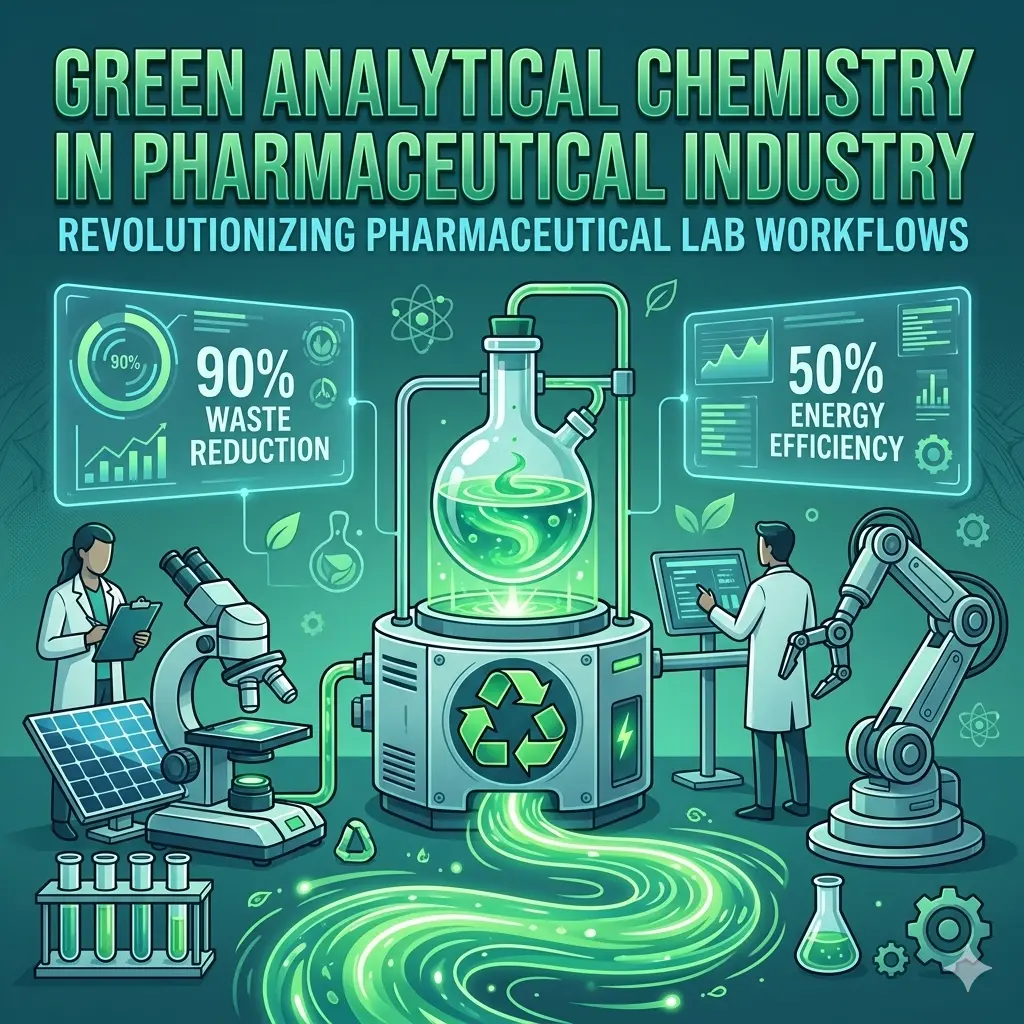
Green Analytical Chemistry (GAC) has long been discussed in academic circles, often framed around environmental metrics and solvent toxicity. However, in pharmaceutical Quality Control (QC) and Research & Development (R&D) laboratories, the conversation has shifted. Today, green analytical chemistry is not merely an environmental aspiration, it is a strategic tool for improving efficiency, robustness, and long-term sustainability of analytical operations.
iIn modern pharmaceutical environments, analysts face increasing pressure to:
- deliver higher throughput with fewer resources,
- reduce operational costs without compromising compliance,
- maintain analytical robustness across the method lifecycle,
- and align laboratory practices with corporate ESG and sustainability goals.
Shorter run times, lower solvent consumption, and simplified methods often result in:
- improved system suitability consistency,
- reduced column stress,
- lower method variability,
- and faster decision-making across development and routine release testing.
This first part of the series establishes the practical foundation of green analytical chemistry as applied to pharmaceutical QC and R&D, focusing on what green really means in regulated laboratories and how it supports high-throughput, compliant analytics.
2. Redefining Green Analytical Chemistry for QC and R&D Laboratories
2.1 Beyond Academic Definitions
Traditional green analytical chemistry frameworks emphasize:
- solvent toxicity,
- waste generation,
- and environmental impact metrics.
While these are important, pharmaceutical laboratories must expand the definition to include operational and regulatory realities.
In QC and R&D environments, a green analytical method should simultaneously:
- reduce solvent and energy consumption,
- increase analytical throughput,
- maintain or improve method robustness,
- and remain fully compliant with regulatory expectations.
Rule #1
Green analytical chemistry is a balance between sustainability and analytical performance, not a trade-off.
2.2 Practical Green KPIs for Pharmaceutical Labs
For QC and R&D teams, the following metrics are far more meaningful than abstract sustainability scores:
- Solvent volume per analysis (mL/run)
- Total run time per sample
- Samples analyzed per day
- Column lifetime (number of injections)
- Waste disposal volume per year
- Energy consumption per batch
When these parameters improve, laboratories typically observe:
- reduced operational costs,
- fewer deviations related to system suitability,
- and increased confidence during inspections.
3. The Strategic Value of Green Analytical Chemistry in R&D
In pharmaceutical R&D, analytical methods often evolve rapidly. Early-phase methods tend to be exploratory, but many ultimately migrate into late-stage development and QC. Designing green analytical methods early offers long-term advantages.
3.1 Faster Development, Faster Decisions
High-throughput green HPLC methods allow:
- rapid screening of formulations,
- faster stability data generation,
- and more efficient Design of Experiments (DoE).
Shorter run times directly translate into:
- higher experimental throughput,
- faster optimization cycles,
- and better use of development timelines.
3.2 Designing with Lifecycle Thinking
Analytical methods developed in R&D should anticipate:
- routine QC deployment,
- long-term robustness,
- and scalability across laboratories.
If we're talking about Robustness and sustainability, How could Green Chemistry help the method Life Cycle ??
It is simply By encouraging:
- simpler mobile phases,
- robust column chemistries,
- and reduced reliance on aggressive conditions.
4. Green Analytical Chemistry in Routine Quality Control
In QC laboratories, analytical methods may be executed thousands of times per year. Even small inefficiencies become magnified over time.
4.1 High-Throughput Is a Sustainability Strategy
Reducing an HPLC run from 15 minutes to 6 minutes may appear modest on paper, but in a routine QC environment it can result in:
- doubling daily sample capacity,
- reducing solvent consumption by more than 50%,
- and lowering instrument downtime.
4.2 Robustness Over Complexity
A recurring issue in QC is over-engineered analytical methods, which is illustrated by:
- excessive column length,
- unnecessarily low flow rates,
- overly complex gradients,
- and high buffer concentrations.
Such methods often:
- stress columns,
- increase system backpressure,
- and show greater sensitivity to small variations.
Rule #2
In GAC, Simplification is always favoured over Complexity
5. Regulatory Perspective: Green Does Not Mean Non-Compliant
One of the most persistent myths in pharmaceutical laboratories is that greener analytical methods are viewed unfavorably by regulators. In reality, regulatory agencies are method-agnostic, they mainly focus on data quality, robustness, and scientific justification.
5.1 Regulatory Flexibility
Guidelines such as:
- ICH Q2(R2) (Analytical Validation),
- ICH Q14 (Analytical Procedure Development),
- USP <1220> and <1092>
explicitly support:
- method optimization,
- lifecycle management,
- continuous improvement.
Rule #3
Backed up by the appropriate justifications, go for: shorter columns, UHPLC systems and reduced solvent volumes.
5.2 Documentation Is the Key
Green analytical improvements must be:
- scientifically justified,
- risk-assessed,
- and clearly documented.
When supported by validation, robustness, and trending data, greener methods are often viewed as improvements, not risks.
6. Common Misconceptions About Green Analytical Chemistry
Misconception 1: Green methods are less robust: In practice, many green methods show better robustness due to reduced system stress and simpler conditions.
Misconception 2: Green means expensive: While initial investment (e.g., UHPLC) may be higher, operational savings in solvent, time, and maintenance often outweigh costs.
Misconception 3: Green chemistry is only for R&D: QC laboratories often benefit the most due to method repetition and scale.
7. Where This Series Goes Next
This article series is structured to move from principles to execution:
- Part 1 (this article): Foundations and strategic value of green analytical chemistry in QC & R&D
- Part 2: Practical green HPLC strategies — columns, flow rates, gradients, and mobile phase optimization
- Part 3: Advanced and emerging approaches — green dissolution testing, micro-scale methods, and future trends
8. Conclusion
Green analytical chemistry represents a natural evolution of pharmaceutical analysis, not a departure from established principles. For both QC and R&D laboratories, sustainable analytical methods offer tangible benefits:
- higher throughput,
- improved robustness,
- lower operational costs,
- and long-term regulatory confidence.
By redefining green analytical chemistry through the lens of performance and compliance, pharmaceutical laboratories can achieve sustainability without compromise.
The following parts of this series will translate these principles into actionable HPLC and dissolution strategies that analysts can implement immediately.
References
- ICH Q2(R2), Validation of Analytical Procedures
- ICH Q14, Analytical Procedure Development
- USP <1092>, The Dissolution Procedure: Development and Validation
- USP <1220>, The Analytical Procedure Lifecycle
- FDA Guidance for Industry, Analytical Procedures and Methods Validation
- Gałuszka A. et al., Green Analytical Chemistry: Theory and Practice, Elsevier
- Tobiszewski M. et al., Green Chemistry Metrics in Analytical Sciences, Trends in Analytical Chemistry