- Introduction
- The analytical limit must come before the analytical method
- Choosing the analytical platform: one technology does not fit all
- Sample preparation: frequently the real analytical bottleneck
- Poor recovery: determine where the analyte is being lost
- Internal standards: an important defence against matrix variability
- Preventing artefactual nitrosamine formation
- Validation should focus on the regulatory decision point
- From method validation to analytical lifecycle management
- Conclusion
1. Introduction
The first part of this series examined the origins and formation mechanisms of nitrosamines, along with their sources of risk and the regulatory lessons they offer. Identifying a potential nitrosamine risk raises another challenging question: Can it be detected and quantified reliably at the relevant concentration?
This is where nitrosamine control becomes analytically demanding.
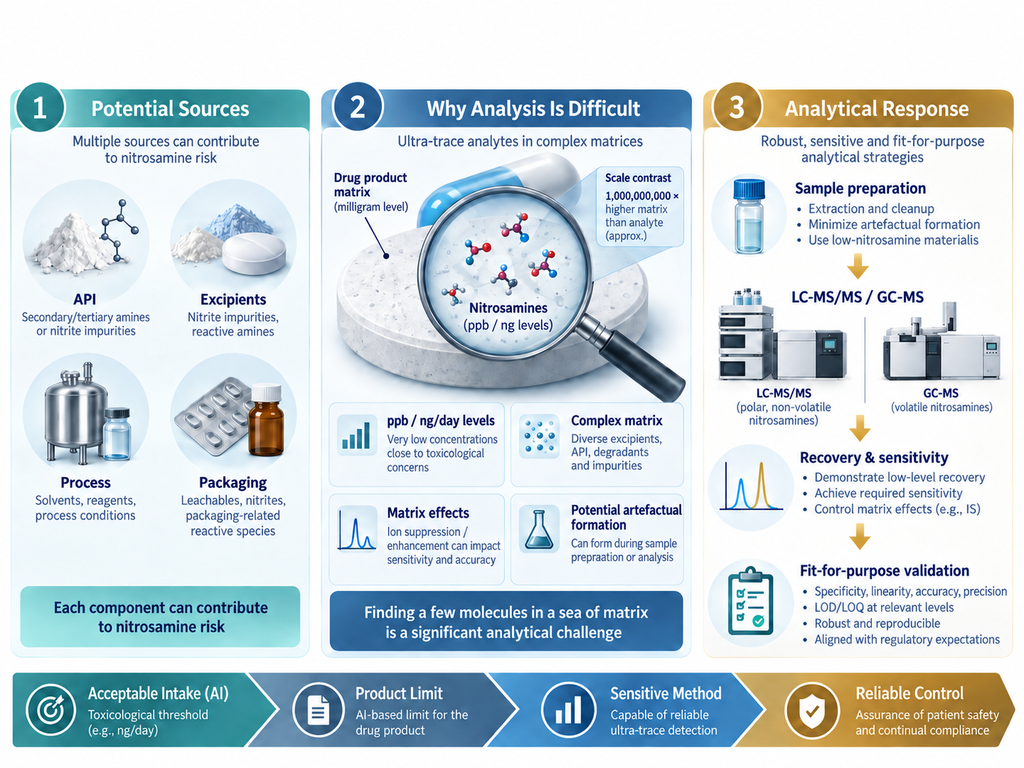
Unlike conventional pharmaceutical impurities, nitrosamines often have to be quantified at parts-per-billion (ppb) level. The emergence of nitrosamine drug-substance-related impurities (NDSRIs) has made the analytical problem broader: it now extends beyond relatively small, volatile compounds such as NDMA and NDEA to structurally complex molecules that are often non-volatile and closely related to the active pharmaceutical ingredient (API). Current regulatory expectations go beyond simply having an LC-MS or GC-MS method. The procedure must be sensitive and selective enough, accurate, and scientifically suitable for the particular drug substance or finished-product matrix. When confirmatory testing is required, the FDA specifically recommends sensitive methods that have been appropriately validated. EMA, meanwhile, directly connects the required analytical sensitivity to the applicable acceptable intake.
The central analytical challenge is this: detecting an extremely small amount of nitrosamine amid an overwhelmingly larger quantity of API and excipients, while ensuring that the analyte is not lost, created, or misrepresented during analysis.
2. The analytical limit must come before the analytical method
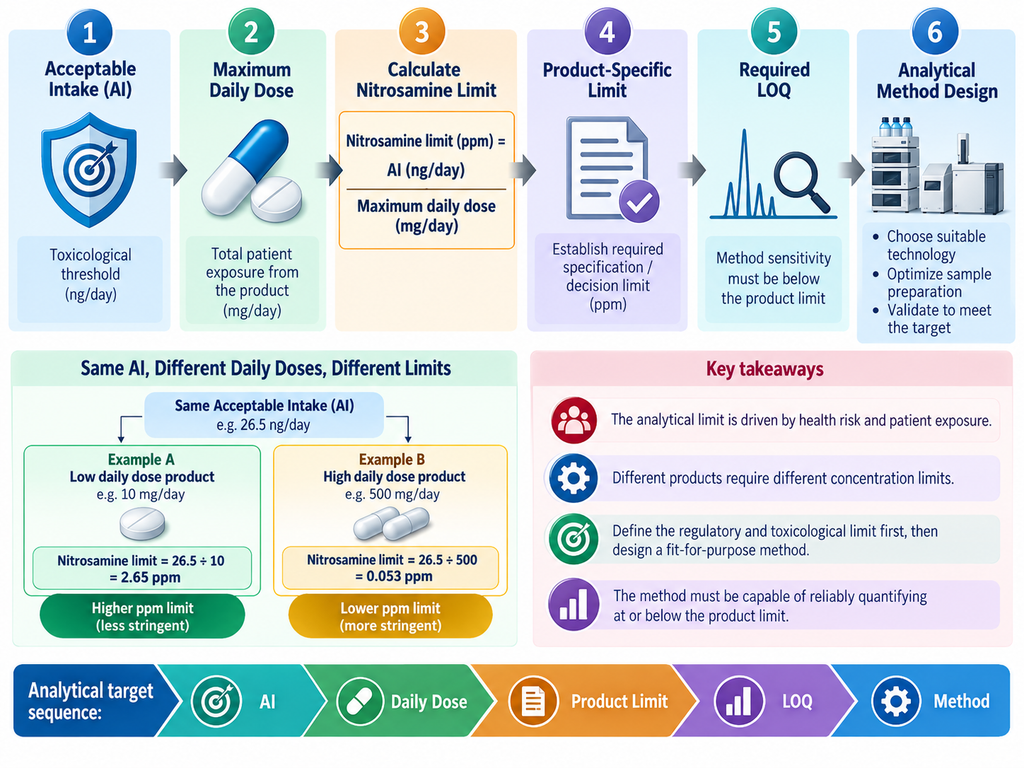
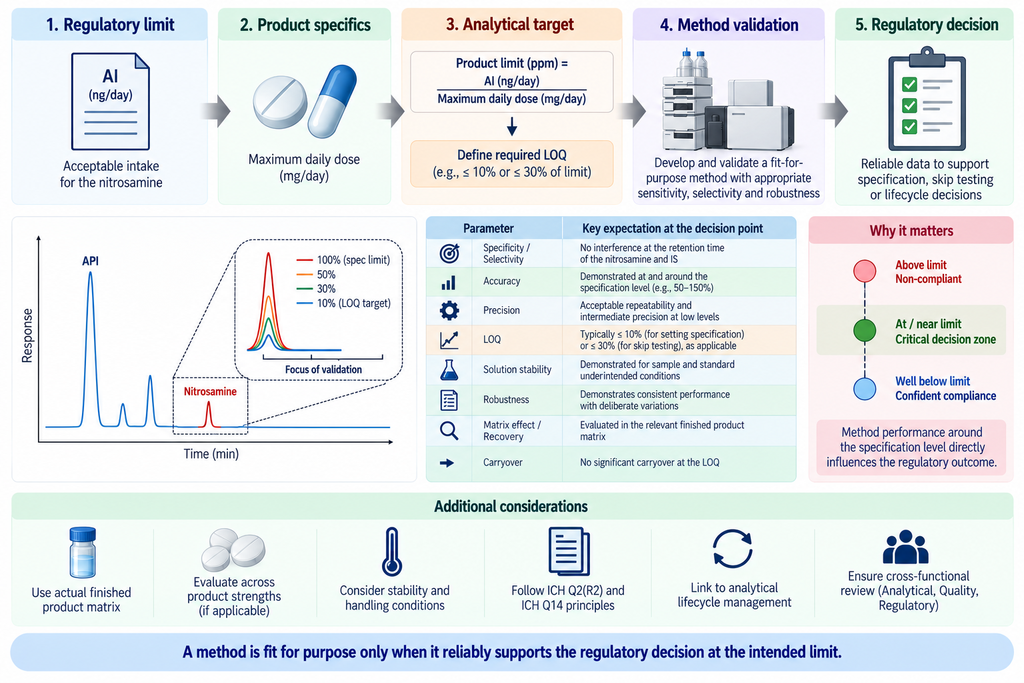
A common mistake in impurity method development is to start with the instrument. For nitrosamines, development should begin with the acceptable intake (AI) and the pharmaceutical product’s maximum daily dose. The approximate concentration limit can be calculated as follows:
Nitrosamine limit (ppm) = AI (ng/day) / Maximum daily dose (mg/day)
This relationship has significant analytical implications. When a high-dose pharmaceutical product contains a compound with a low AI, the required quantitative limit may be extremely low. FDA likewise emphasizes that converting an AI into a product concentration depends on the maximum daily dose. EMA also distinguishes analytical capability based on the intended use of the testing. If testing is used to support omitting a specification, the analytical procedure should generally have an LOQ at or below 10 % of the acceptable limit. When quantitative data justify skip testing, an LOQ at or below 30% is expected.
An analytical target should therefore be set before experimentation begins:
AI → Maximum daily dose → Product limit → Required LOQ → Analytical technology → Sample preparation strategy.
Following this sequence prevents the development of a technically impressive method that ultimately fails to provide sufficient regulatory sensitivity.
3. Choosing the analytical platform: one technology does not fit all
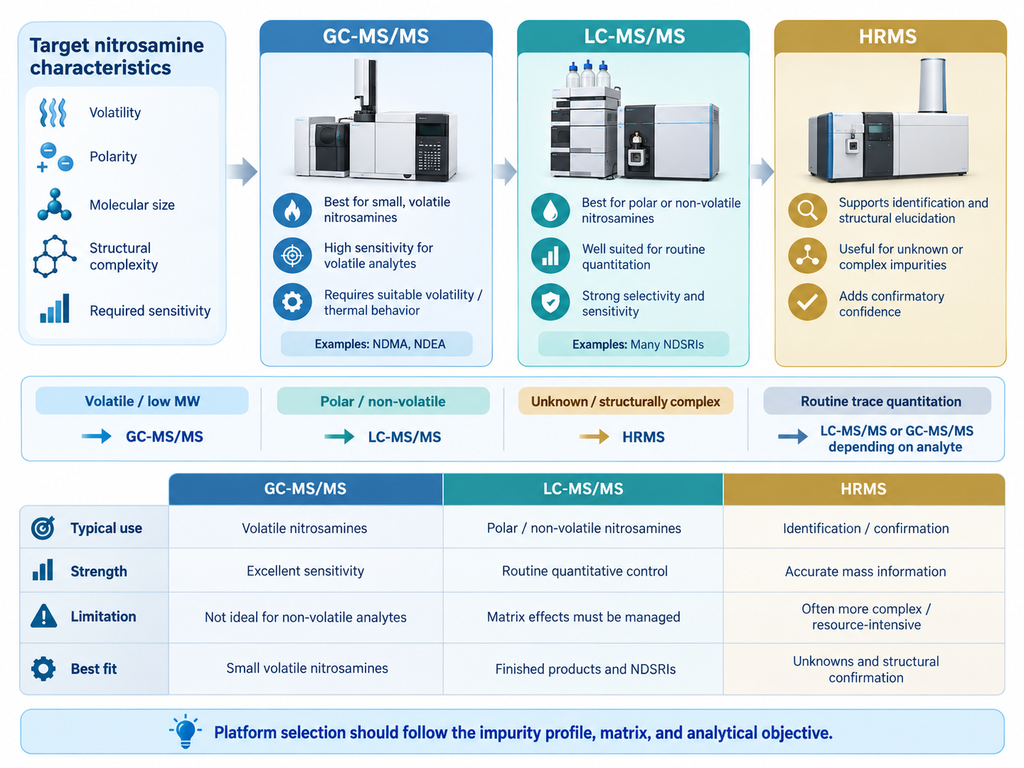
Nitrosamines differ substantially in molecular weight, volatility, polarity, ionization behavior, and chemical stability. The analytical method therefore needs to match the target impurity’s physicochemical properties, rather than being chosen on the basis of a preferred platform. For relatively small, volatile nitrosamines, GC-MS/MS, or GC-HRMS remains highly useful. LC-MS/MS, by contrast, has become especially important for non-volatile and structurally complex NDSRIs. High-resolution mass spectrometry (HRMS) can also increase confidence in impurity identification and structural elucidation. LC-MS/MS—especially triple-quadrupole instruments run in multiple-reaction-monitoring mode—offers the sensitivity and selectivity needed for routine quantitative work.
Recent studies have also shown, though, that carefully optimized single-quadrupole LC-MS systems can sometimes reach the sensitivity required for selected NDSRIs. Instrument sophistication alone, then, is not enough to establish analytical capability; that capability has to be demonstrated. The best analytical platform is not necessarily the most sophisticaed instrument. It is the simplest system that can consistently meet the analytical target with adequate specificity, sensitivity, robustness, and transferability.
4. Sample preparation: frequently the real analytical bottleneck
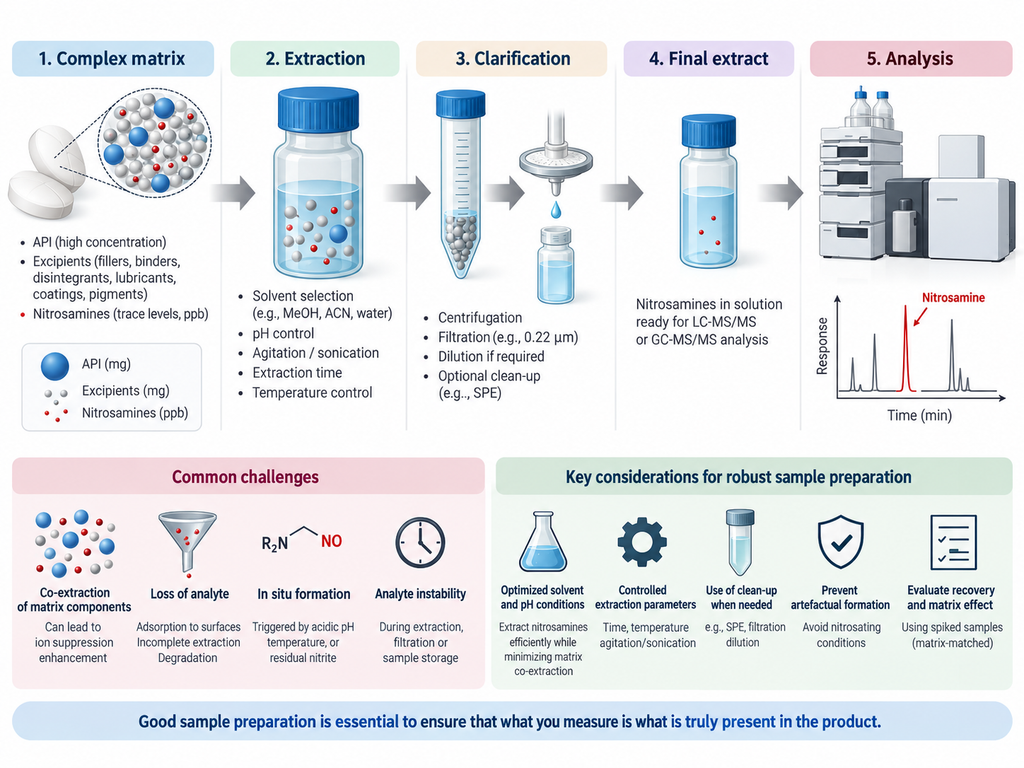
When analytes are present at trace levels, preparing the sample can matter just as much as detecting them by mass spectrometry. Finished dosage forms contain APIs, fillers, binders, disintegrants, lubricants, coatings, pigments, polymers, and other components—often at concentrations several orders of magnitude higher than that of the nitrosamine being measured. During analysis, these substances may interfere with analyte extraction or change electrospray ionization, leading to suppression or enhancement of the MS response. Recent analytical reviews identify complex matrices, poor extraction, matrix effects, and possible in situ formation as major challenges in nitrosamine testing.
The extraction solvent therefore has to meet two competing goals: extract the nitrosamine efficiently while bringing as little interfering matrix into solution as reasonably possible. A stronger solvent or longer extraction time will not necessarily improve the method. If extraction is too aggressive, additional excipients and API may be released, which can worsen ion suppression. Variables that merit systematic assessment include solvent composition, the aqueous-to-organic ratio, pH, extraction time, agitation or sonication, sample concentration, centrifugation, filtration, dilution, and, when needed, selective clean-up methods such as solid-phase extraction.
5. Poor recovery: determine where the analyte is being lost
A central troubleshooting principle in nitrosamine analysis is that poor recovery and a weak detector response do not necessarily arise from the same problem. Suppose an API solution gives approximately quantitative recovery, while a spiked finished-product or placebo preparation gives substantially lower recovery. In that situation, changing the MS parameters right away may accomplish very little; the issue could be coming from the matrix rather than the detector.
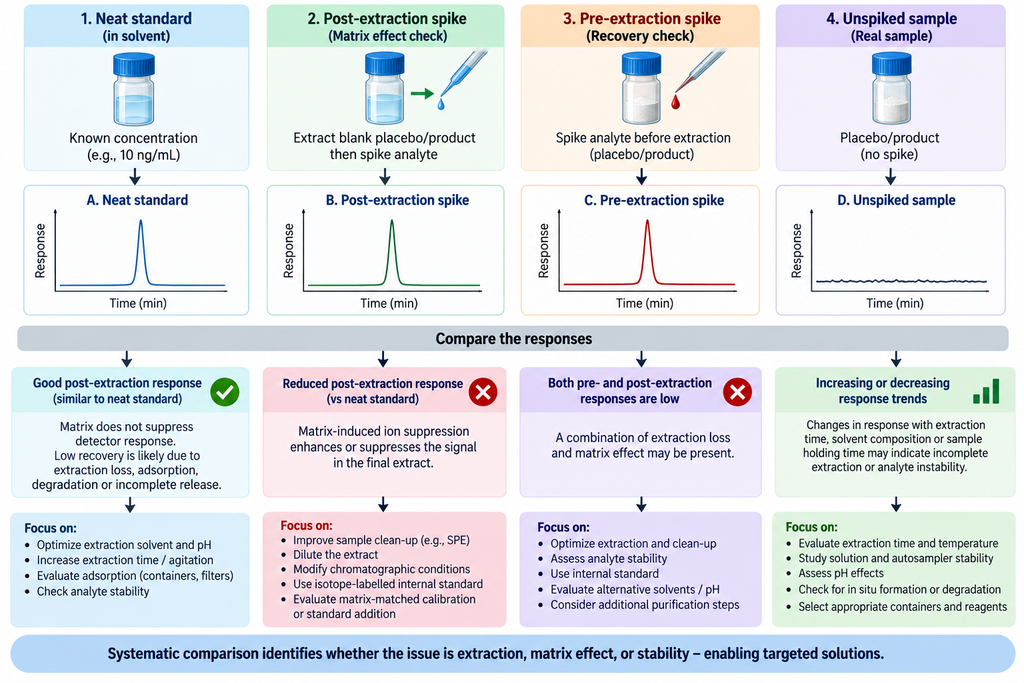
One useful development experiment is to compare three preparations: Experiment Primary question answered Neat standard What is the intrinsic analyte response? Extracted placebo + post-extraction spike. Is the matrix suppressing or enhancing ionization? Placebo + pre-extraction spike Is the analyte being lost during extraction or sample preparation? This comparison can separate three fundamentally different problems.
Poor pre-extraction recovery alongside a good post-extraction response points to extraction loss, adsorption, degradation, or incomplete analyte release. If both pre- and post-extraction responses are reduced, significant matrix-induced ion suppression is suggested. A response that increases with extraction time or changes in solvent composition may indicate incomplete extraction. By contrast, declining concentrations as sample holding time increases may point to analyte instability. This diagnostic approach is far more efficient than repeatedly altering columns, mobile phases, or MS parameters before determining what is causing the analytical bias.
6. Internal standards: an important defence against matrix variability
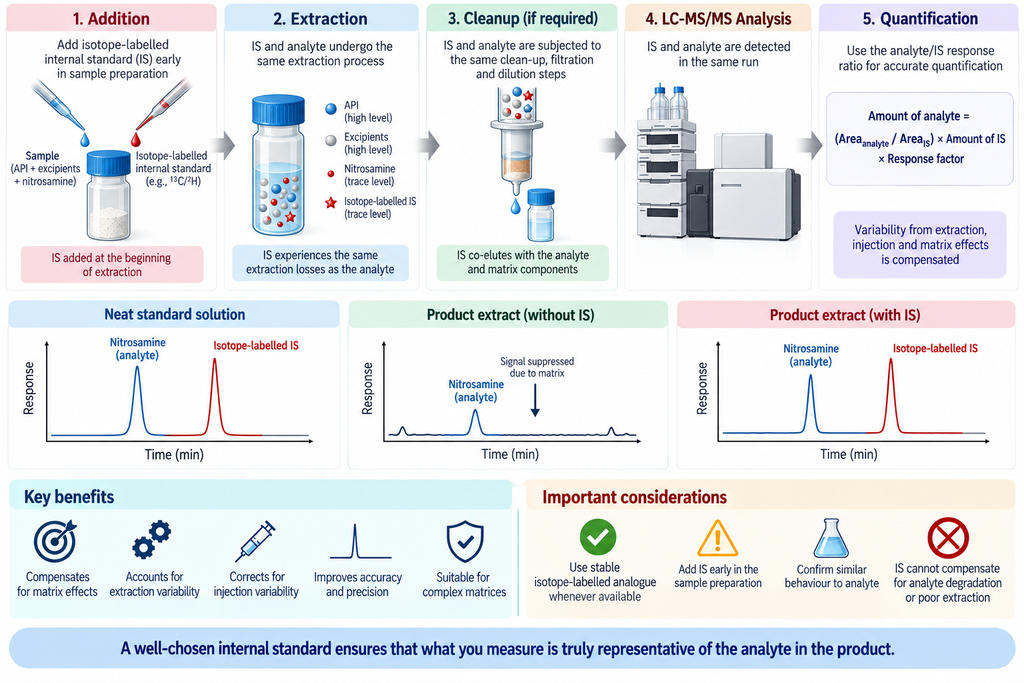
In demanding LC-MS/MS applications, especially when working with finished dosage forms, stable isotope-labelled internal standards are among the strongest analytical tools available. Ideally, the internal standard should behave nearly the same as the target nitrosamine throughout extraction, chromatography, ionization, and detection, yet remain distinguishable through its mass transition. Adding it at the beginning of sample preparation can account for variability from sample handling, injection volume, ionization efficiency, and matrix effects.
Recent NDSRI method-development work has specifically shown that deuterated nitrosamine internal standards can control formulation-dependent matrix effects. However, internal standards should not be used to conceal fundamentally poor sample recovery. When an analyte has degraded chemically, been irreversibly adsorbed, or extracted only partially, the standard can compensate adequately only if it behaves in a sufficiently similar way. Where an exact isotope-labelled analogue cannot be obtained, possible alternatives are matrix-matched calibration, standard addition, or a structural analogue supported by a careful justification. Even so, an isotope-labelled version of the analyte is still the preferred option whenever it is practically available.
7. Preventing artefactual nitrosamine formation
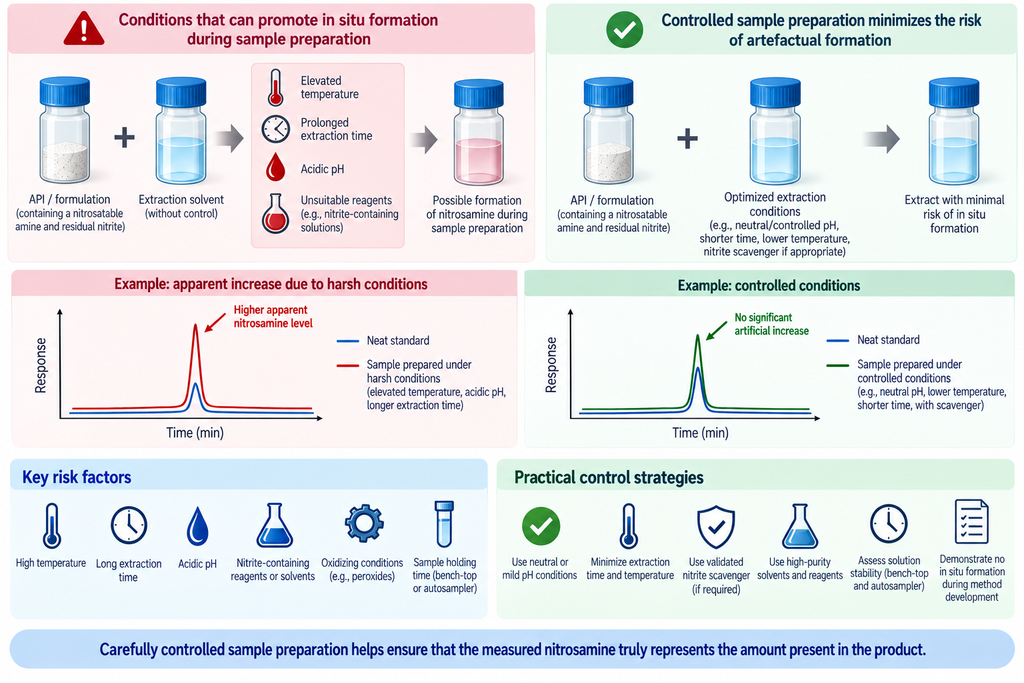
Nitrosamine analysis has another unusual feature: the analytical procedure itself may create the impurity it is intended to measure. When a formulation contains both a nitrosatable amine and residual nitrite, unsuitable sample-preparation conditions can promote nitrosation. Higher temperatures, extended extraction times, acidic conditions, or inappropriate reagents may then cause the measured nitrosamine concentration to appear falsely elevated. This draws an important distinction: Was the nitrosamine already in the pharmaceutical product, or did some form later inside the analytical flask?
Recent literature still points to in situ formation during sample preparation as a significant source of analytical error. For instance, a 2026 LC-MS/MS study used a scavenging strategy during sample preparation to prevent the analytical formation of an NDSRI. For method development, analysts should test sample-preparation conditions in controlled studies, varying extraction time, temperature, pH, solution-hold time and autosampler stability. Any nitrite-quenching or scavenging approach under consideration must be scientifically evaluated to show that it prevents new formation without destroying, transforming, or otherwise affecting the recovery of nitrosamine already present in the sample. This point matters because avoiding an artificial positive should not result in an artificial negative.
8. Validation should focus on the regulatory decision point
Nitrosamine methods need validation as trace analytical procedures, not the mechanical application of standard impurity-validation templates. ICH Q2(R2) and Q14 now set out an integrated framework that connects analytical procedure development and validation with robustness, risk management, and lifecycle control. The critical characteristics generally include specificity/selectivity, accuracy, precision, LOQ, calibration model and range, recovery, matrix effect, robustness, carryover, solution stability, and suitable system suitability. Performance near the LOQ and the regulatory specification deserves particular scrutiny: at that point, the analytical result determines the compliance decision. A method may show excellent precision at 100 times the regulatory limit, yet offer limited assurance if its recovery becomes unstable near the required LOQ. Likewise, where applicable, validation should be performed using the finished product matrix itself. Accuracy demonstrated in the solvent or API alone does not automatically show that the method is suitable for tablets, capsules, solutions, suspensions, or other formulations that contain interfering excipients. For mass-spectrometric procedures, controls such as retention-time agreement, qualifier-to-quantifier ion relationships, internal-standard response, and calibration/QC performance can offer additional assurance of analytical identity and batch validity.
9. From method validation to analytical lifecycle management
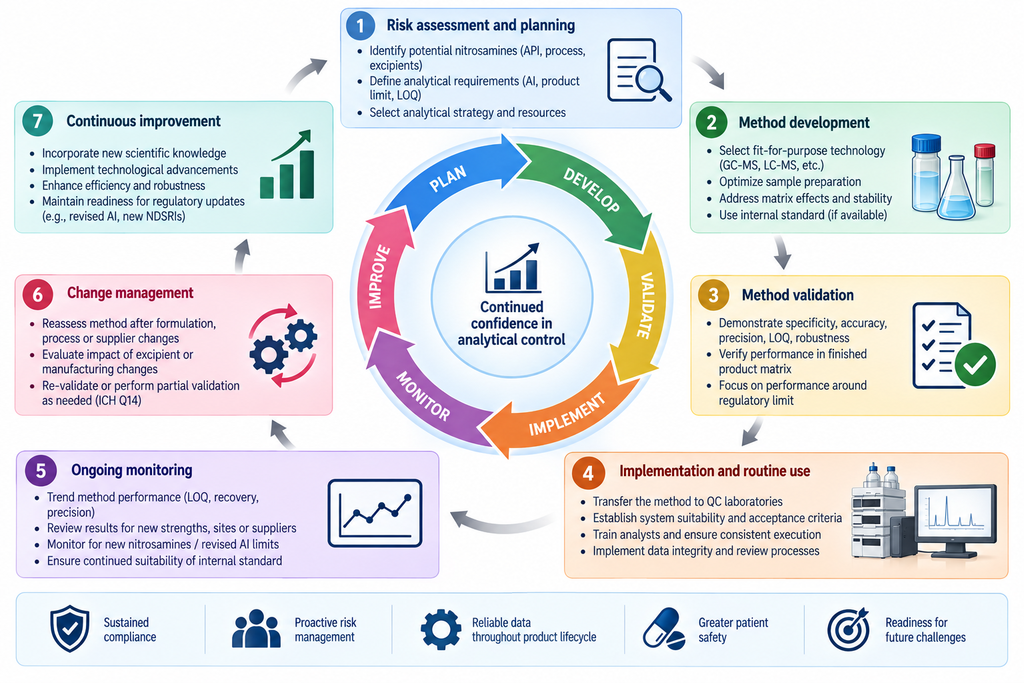
Nitrosamine methods should be treated as dynamic processes, evolving from initial validation to ongoing analytical lifecycle management. Changes in formulation, excipient suppliers, manufacturing processes, product strengths, and emerging NDSRIs may affect analytical performance. EMA continues to stress lifecycle responsibility for nitrosamine risk, and ICH Q14 sets out a broader framework for keeping analytical procedures in a state of control throughout their lifecycle. An effective analytical control strategy should therefore revisit the following at regular intervals:
Matrix effects → extraction recovery → analytical sensitivity → analyte stability → method robustness → regulatory AI.
This matters especially when authorities change acceptable intake limits or newly identified NDSRIs are added to the product risk assessment. The FDA’s nitrosamine information resource is also continually updated, including its AI limits and emerging scientific information.
10. Conclusion
Nitrosamine analysis represents considerably more than achieving a low instrumental detection limit. The most dependable analytical approach starts by translating the acceptable intake into a target for the specific product. From there, the method should be chosen to meet that target, with sample preparation designed around the chemistry of both the nitrosamine and the pharmaceutical matrix. Of the analytical problems involved, sample recovery, matrix effects, analyte stability, and artefactual formation warrant special attention. Each can generate results that appear convincing analytically while being scientifically wrong. The changing regulatory environment is moving nitrosamine testing beyond a simple “detect and quantify” model toward a much stronger approach: understand, control, verify, and monitor continuously. Ultimately, the most defensible nitrosamine method is not necessarily the one with the lowest numerical LOQ. It is the one that can show the measured concentration reliably reflects the amount of nitrosamine actually present in the pharmaceutical product.
Note: This article is Part 2 of a structured series on nitrosamines in pharmaceuticals. Part 1 covered their origins, formation mechanisms, risk sources, and regulatory lessons. Here, the focus shifts to analytical challenges and strategies. Later parts may examine formulation and manufacturing mitigation strategies, regulatory control frameworks, and emerging approaches to predictive nitrosamine risk management.