Introduction to Nitrosamine Impurities
Nitrosamines are chemical compounds of major concern in the pharmaceutical industry because of their carcinogenic potential. Since their detection in several medicines in 2018, regulators have implemented global strategies to identify and minimize these impurities.
This article explains how nitrosamines form, the mechanisms behind their reactions, and the current WHO and ICH guidelines for controlling them.
Chemistry of Nitrosamine Formation
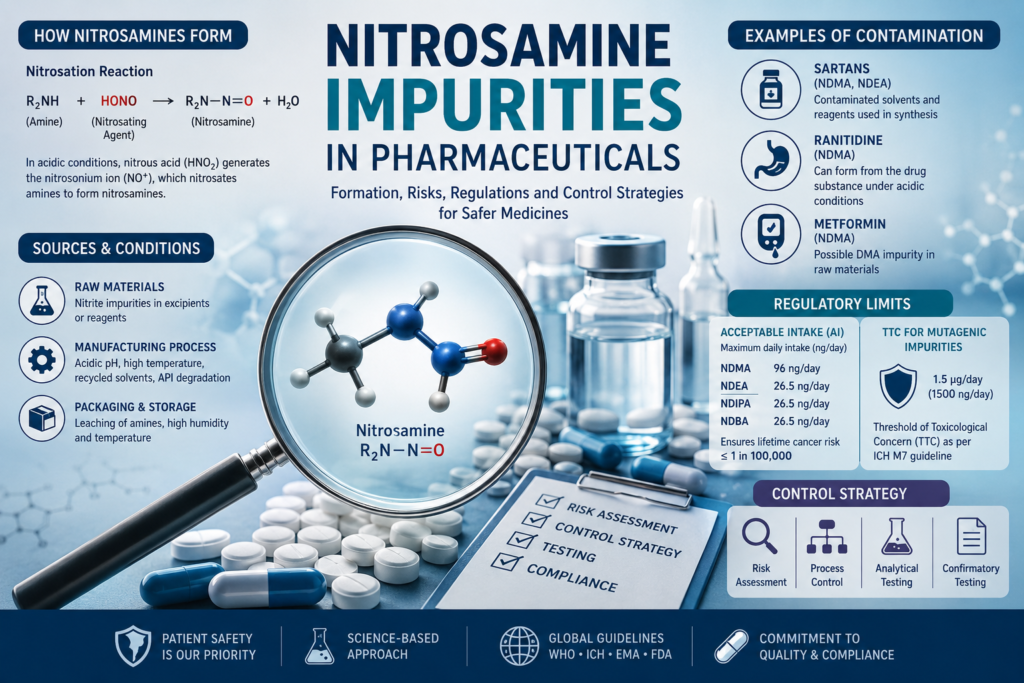
Nitrosamines (R₂N–N=O) form through a nitrosation reaction between an amine and a nitrosating agent.
Key Reactants
- Amines: Secondary amines (R₂NH) react directly; tertiary amines (R₃N) first dealkylate to secondary forms.
- Nitrosating Agents: Nitrous acid (HNO₂), nitrosyl halides (NOCl), nitrous anhydride (N₂O₃), or organic nitrites (RONO).
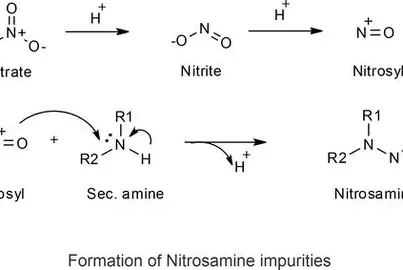
Reaction Mechanism:
- HONO + R₂NH → R₂N-NO + H₂O, In acidic media, nitrosonium ion (NO⁺) acts as the active nitrosating species, attacking the amine nitrogen.
Sources and Conditions in Pharmaceutical Manufacturing
Raw Materials and Excipients
- Nitrite impurities in excipients may generate nitrosating agents under acid or heat.
- Amine impurities can exist in APIs or solvents and react with nitrosating species.
Manufacturing Process
- pH and temperature: Acidic and high-temperature conditions accelerate nitrosation.
- Recycled solvents: DMF degradation releases DMA, forming NDMA.
- API degradation: Certain APIs (e.g., ranitidine) can self-generate nitrosamines.
Packaging and Storage
- Packaging may leach reactive amines.
- High humidity and temperature increase degradation risk.
Examples of Nitrosamine Contamination
1. Sartans (Valsartan, Losartan, Irbesartan)
The initial discovery of nitrosamine contamination in sartans, a class of angiotensin II receptor blockers (ARBs), brought this issue to the forefront. The primary cause was traced to the use of contaminated solvents and reagents during the manufacturing process.
For example, NDMA and NDEA were found in valsartan due to the use of N,N-dimethylformamide (DMF) as a solvent, which could contain or generate dimethylamine (DMA) and diethylamine (DEA) impurities, respectively. These amines then reacted with
residual nitrites or other nitrosating agents present in the manufacturing process.
2. Ranitidine (Zantac)
Ranitidine, a histamine H2-receptor antagonist, was found to be susceptible to NDMA formation due to its inherent chemical structure. The molecule contains a dimethylamino group that can readily react with nitrites, especially under acidic conditions (e.g., during manufacturing with acidic excipients), to form NDMA. This was a significant finding as the impurity was not necessarily introduced from external contamination but could form from the drug substance itself.
3. Metformin
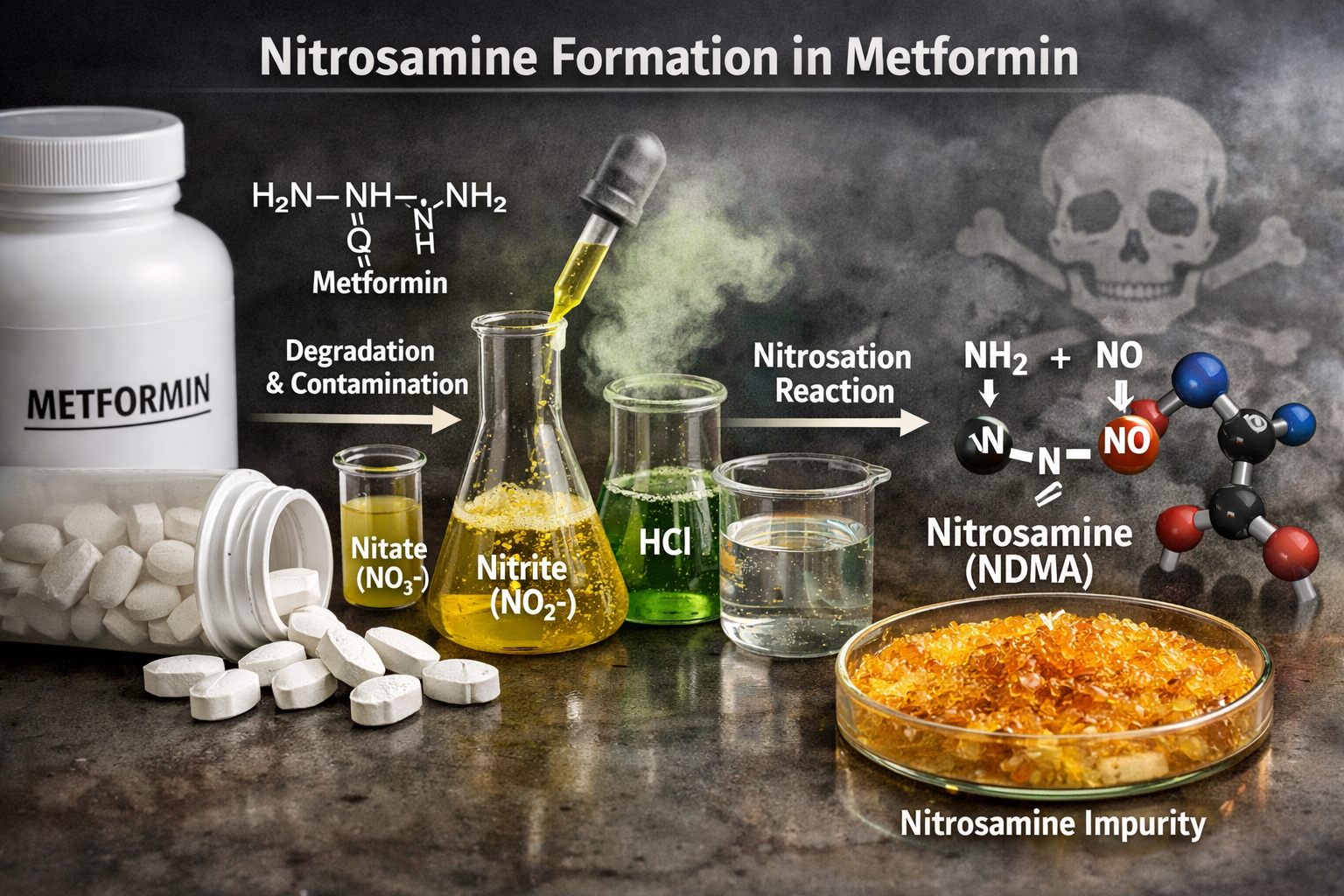
Metformin, a widely used antidiabetic drug, has also been associated with NDMA contamination. While the exact mechanisms can vary, potential sources include the presence of dimethylamine (DMA) as an impurity in metformin or its raw materials, which can then react with nitrosating agents.
Regulatory Limits and Acceptable Intakes
Regulatory bodies worldwide, including the EMA, WHO, and ICH, have established stringent
limits for nitrosamine impurities to ensure patient safety. These limits are based on a
comprehensive understanding of the toxicology of these compounds and aim to minimize
the potential carcinogenic risk over a patient’s lifetime.
Acceptable Intake (AI) Limit
The core concept for controlling nitrosamine impurities is the Acceptable Intake (AI) limit.
This is the maximum amount of a nitrosamine impurity that a person can ingest daily over a lifetime without an appreciable increase in the risk of cancer.
These limits are typically
expressed in nanograms per day (ng/day) and are extremely low, reflecting the high potency of some nitrosamines as probable human carcinogens.
For many common nitrosamines, the AI limits are:
- N-nitrosodimethylamine (NDMA): 96 ng/day
- N-nitrosodiethylamine (NDEA): 26.5 ng/day
- N-nitrosodiisopropylamine (NDIPA): 26.5 ng/day
- N-nitrosodibutylamine (NDBA): 26.5 ng/day
These values are derived to ensure that the theoretical lifetime cancer risk from exposure to these impurities is no more than 1 in 100,000.
It’s important to note that these are general guidelines, and specific limits may vary slightly between different regulatory agencies or for different drug products based on their maximum daily dose and duration of treatment.
Threshold of Toxicological Concern (TTC)
The ICH M7 guideline introduces the Threshold of Toxicological Concern (TTC) concept for
mutagenic impurities, including nitrosamines, especially when compound-specific carcinogenicity data is limited. The TTC represents an intake level below which a compound is considered to pose a negligible risk of carcinogenicity. For mutagenic impurities, a TTC value of 1.5 μg/day (1500 ng/day) is generally applied.
Product-Specific Limits
For a given drug product, the acceptable limit for a nitrosamine impurity is calculated
based on its AI limit and the maximum daily dose (MDD) of the drug. The formula is
typically:
Limit (ppm) = (AI (ng/day) / MDD (mg/day)) * 1000
For example, if a drug has an MDD of 100 mg/day and the AI for a specific nitrosamine is 26.5 ng/day, the acceptable limit for that nitrosamine in the drug product would be:
(26.5 ng/day / 100 mg/day) * 1000 = 0.265 ppm
This calculation ensures that a patient taking the maximum daily dose of the medication will not exceed the acceptable daily intake of the nitrosamine impurity.
Control Strategy and Testing
Product owners and manufacturers are required to implement robust control strategies to ensure that nitrosamine impurities are either absent or present below their respective AI limits. This involves:
Risk Assessment
Identifying potential sources of nitrosamines throughout the entire
manufacturing process and supply chain.
Process Control
Implementing measures to prevent or minimize the formation of
nitrosamines, such as optimizing reaction conditions, controlling raw material specifications, and using appropriate scavenging agents.
Analytical Testing
Developing and validating sensitive analytical methods to detect
and quantify nitrosamines at very low levels. Regular testing of raw materials, intermediates, and finished products is crucial.
Confirmatory Testing
If a potential risk is identified, confirmatory testing of the
finished product is required to verify that nitrosamine levels are below the acceptable
limits.
Conclusion
For product owners, understanding these regulatory limits and the underlying principles is paramount.
It necessitates a proactive approach to quality management, beginning with a thorough risk assessment of all components and processes involved in drug manufacturing. Compliance with these regulations is not merely a legal requirement but a fundamental commitment to patient safety. By adhering to the established AI limits and implementing comprehensive control strategies, product owners can ensure the continued quality and safety of their pharmaceutical products in a globally regulated environment.
References
[1] Moser, J., Ashworth, I. W., Harris, L., Hillier, M. C., Nanda, K. K., & Scrivens, G. (2023). NNitrosamine
Formation in Pharmaceutical Solid Drug Products: Experimental Observations.
Journal of Pharmaceutical Sciences, 112(5), 1255-1267.
https://www.sciencedirect.com/science/article/abs/pii/S002235492300028X
[2] World Health Organization. (2024). WHO good manufacturing practices considerations
for the prevention and control of nitrosamine contamination in pharmaceutical products.
https://cdn.who.int/media/docs/default-source/medicines/norms-and-standards/currentprojects/
qas24_943_gmp_nitrosamines_forpublic52f95166-1c71-4cc2-a499-
05bc4967bf14.pdf
[3] International Council for Harmonisation. (2023). ICH Harmonised Guideline M7(R2):
Assessment and Control of DNA Reactive (Mutagenic) Impurities in Pharmaceuticals to
Limit Potential Carcinogenic Risk.
https://database.ich.org/sites/default/files/ICH_M7(R2)_Guideline_Step4_2023_0216_0.pdf