Excipient compatibility studies help pharmaceutical development teams identify drug–excipient interactions that could reduce potency, increase impurities, or change how a finished product performs. A filler provides bulk, a binder helps particles hold together, and a surfactant improves wetting. Each of these materials can also influence the chemical or physical environment around the active pharmaceutical ingredient (API).
A well-designed study helps teams select excipient grades, recognize process sensitivities, and decide which risks to investigate in the finished dosage form. The evidence can also inform packaging selection, supplier controls, and later investigations.

What Are Excipient Compatibility Studies?
Excipient compatibility studies investigate how an API behaves with the materials proposed for its formulation under defined conditions. The development question is whether the selected materials can work together through manufacturing, storage, and, where relevant, product use.
The most informative measurements depend on the dosage form. For a tablet, impurity formation and dissolution may be priorities. For an aqueous suspension, particle growth, pH drift, and redispersibility can matter. For a gelatin capsule, the interaction between the fill and the shell can affect drug release. Findings apply to the specific materials, compositions, and conditions evaluated.
Compatibility Studies and Finished-Product Stability
| Aspect | Excipient compatibility studies | Finished-product stability studies |
| Primary purpose | Investigate material interactions | Measure how finished-product quality changes over time |
| Typical samples | API controls, mixtures, placebos, and prototypes | Representative finished product in the proposed container closure system |
| Exposure | Selected to answer a specific development question | Defined by the applicable stability program |
| Decisions supported | Ingredient selection and material or process controls | Proposed shelf life, storage conditions, and packaging |
Under ICH Q8(R2), pharmaceutical development should evaluate drug-substance compatibility with the formulation excipients. Where relevant, the guideline also addresses interactions among excipients and among active ingredients in combination products. ICH Q1A(R2) describes the stability evidence used to support shelf life and storage conditions. Together, these studies connect ingredient selection with the long-term performance of the finished product. [1, 2]
For more on long-term and accelerated testing, see our guide to pharmaceutical stability studies.
6 Benefits of Excipient Compatibility Studies
1. Protect Drug Potency
When a formulation component accelerates degradation, the amount of intact drug can decrease. Excipient compatibility studies compare the API–excipient mixture with the API alone under matched conditions. If both samples degrade at a similar rate, the team may need to address the API’s intrinsic sensitivity. A faster decline in the mixture justifies investigating the excipient, its grade, or the local conditions it creates.
2. Support Impurity Control
Assay and related-substances testing answer different questions. An individual degradation product can increase while the assay remains within its expected range. Use a suitable stability-indicating method, examine new and known impurity peaks, and compare the pattern with the API control. When extraction or placebo interference is plausible, investigate it before attributing a low assay or an extra peak to degradation.
3. Preserve Drug Release and Product Performance
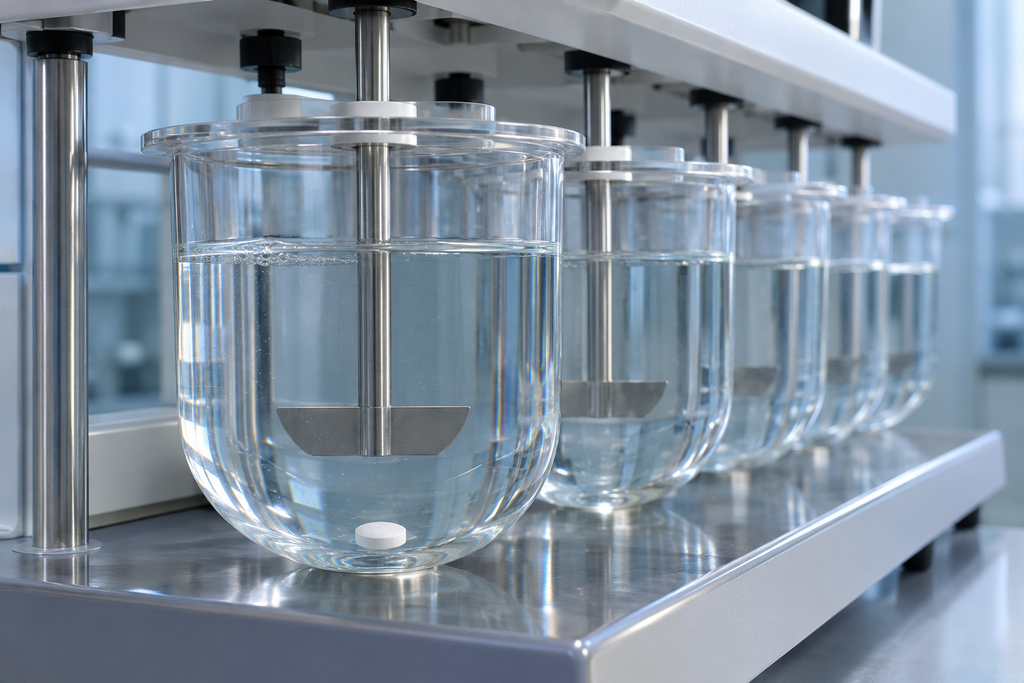
Excipient compatibility studies can identify performance changes even when the API remains chemically intact. For example, the solid-state form and surface area of magnesium stearate can influence tablet lubrication, tabletability, and dissolution. Surface coverage during blending can also affect how readily water enters a tablet. Where drug release is at risk, evaluate dissolution or disintegration in an appropriately processed prototype. [9, 10]
4. Reduce Development Rework
Early excipient compatibility studies give teams time to compare alternative materials or processing routes before finalizing the formulation. An interaction discovered after scale-up may require revisiting the excipient grade, analytical method, process, or packaging. Early screening helps prioritize those decisions while the formulation can still be changed.
5. Justify Excipient Selection
Excipient compatibility studies connect each ingredient’s intended function with the attributes that matter in the product. Record why the grade was selected, what was tested, and which controls follow from the results. For example, a grade selected for its low level of a reactive impurity should be supported by evidence that the attribute matters to the formulation. [1, 3]
6. Strengthen Future Investigations
The original excipient compatibility studies can help investigate an impurity trend, a change in dissolution, or a supplier change. Records are especially useful when they identify the grades, lots, ratios, exposure conditions, methods, and observed trends. This lets another scientist assess whether the historical findings apply to the new material or process.
Common Drug–Excipient Incompatibilities
Chemical effects include degradation and impurity formation. Physical effects include precipitation, phase separation, crystal-form changes, and particle growth. Functional effects arise when the formulation loses a required performance characteristic, such as redispersibility, drug release, or preservative effectiveness. One interaction can affect several of these characteristics.
| Mechanism | What to investigate |
| Maillard reaction | Reducing sugars such as lactose can react with susceptible amine-containing drugs. A published fluvoxamine–lactose investigation used complementary techniques to support interpretation of the thermal findings. [6] |
| Oxidation | Reactive impurities, including peroxides in some grades or lots of povidone or crospovidone, may contribute to degradation of an oxidation-sensitive API. Assess lot differences, moisture, and oxygen exposure where relevant. [3] |
| Hydrolysis | Evaluate how water exposure and pH could influence a hydrolysis-sensitive API. Document humid storage and deliberate water addition as distinct experimental conditions. [2, 3] |
| Nitrosamine formation | Where the API and formulation present a plausible risk, assess potential nitrosating sources, including nitrite in excipients, and use suitable confirmatory testing when indicated. [7] |
| Gelatin cross-linking | Aldehydes or certain storage conditions can contribute to gelatin cross-linking and pellicle formation. Evaluate dissolution in the assembled capsule to capture the effect of the shell. [8] |
An excipient may meet its general specification while still presenting a product-specific risk. For excipient compatibility studies, the relevance of a reactive impurity depends on the API, the amount introduced into the formulation, and the conditions the product encounters. Grade and supplier information make those findings easier to reproduce and apply. [3]
How to Design Excipient Compatibility Studies
Define the Product and the Development Question
Record the dosage form, strength, route, manufacturing approach, proposed packaging, and anticipated storage conditions. Review what is known about the API’s degradation pathways, solubility, moisture sensitivity, and solid state. Use that information to write a question the study can answer.
For example, ask whether a proposed binder increases a monitored oxidative impurity relative to the API control under a defined exposure. The question specifies the comparison, the measured response, and the challenge that will inform the decision.
Select Materials, Mixture Ratios, and Controls
Record each excipient’s grade, supplier, lot, proposed concentration, and function. Choose mixture ratios for the decision at hand. A 1:1 API-to-excipient ratio may serve as an exploratory screen. A formulation-representative ratio helps assess the practical relevance of any finding, particularly in low-dose products with a high excipient-to-API ratio. [5]
| Sample | Role in the study |
| API alone | Establishes the drug’s response to the same exposure |
| Fresh mixture | Provides the baseline before storage |
| Excipient alone or placebo | Helps investigate analytical interference and excipient-related signals |
| Binary mixture | Examines the API with one excipient |
| Ternary mixture | Tests a specific hypothesis involving three components |
| Processed prototype | Evaluates the combined formulation and relevant manufacturing effects |
Use the controls that fit the question. In excipient compatibility studies, a matched API control is particularly important when the exposure itself can degrade the drug. Compare changes over time, and account for method variability before assigning the effect to a material.

Select Exposure Conditions and Sampling Times
Temperature, humidity, light, oxygen, and water addition can help probe different mechanisms. Select conditions and time points that can reveal a trend relevant to the development question. Document the sample quantity, container, closure, and preparation because each can influence the exposure. Chamber relative humidity directly describes the environment outside a sealed vial. Conditions inside depend on the sample, headspace, and closure.
In excipient compatibility studies, a severe stress condition may reveal a degradation pathway that deserves a follow-up experiment. The relevance of that finding depends on whether the effect persists at the intended formulation ratio, in the processed prototype, or under a more representative exposure. A short screen supports decisions within the time and conditions evaluated. [2, 5]
Analytical Methods for Excipient Compatibility Studies
Select methods that can detect the suspected interaction and support the decision. Appearance is a useful screening observation. Chemical, solid-state, and performance questions usually require their own measurements. [4, 6]
| Method | What it can show | Interpretation point |
| Visual examination | Color change, caking, precipitation, or separation | Low-level degradation may be invisible |
| HPLC or UPLC | API assay and impurity trends | Check specificity, placebo interference, and extraction recovery |
| LC–MS | Evidence about possible reaction or degradation products | Structural assignments depend on the quality and interpretation of the data |
| DSC | Thermal events and shifts in thermal behavior | Investigate whether the event relates to a change during relevant exposure |
| FTIR or Raman | Molecular or solid-state changes | Overlapping signals can obscure low-level changes |
| XRPD | Crystalline phases and changes in solid state | Relate the finding to stability, manufacturing, or performance |
| TGA | Mass changes during heating | Supporting evidence may be needed to identify the source of mass loss |
| Dosage-form testing | Dissolution, disintegration, redispersibility, or other performance attributes | Use the dosage form and test conditions relevant to the question |
For chemically focused excipient compatibility studies, first verify that the analytical method recovers the API from the mixture and separates relevant impurities from placebo signals. For a physical question, compare the mixture with its component controls and use a complementary technique where interpretation is uncertain. For a functional question, measure the affected attribute directly in the prototype.

How to Interpret Excipient Compatibility Studies
Start by confirming analytical suitability and reviewing the time-zero results. Then compare each change with its matched controls, consider how it develops over time, and judge whether the conditions represent the proposed product. If a finding could change material selection or processing, test whether it persists in an appropriately processed prototype.
Set investigation thresholds for the specific study. An assay difference has to be interpreted alongside method variability, impurity trends, the API control, and the intended product requirements. The magnitude and consistency of the change help determine the next experiment.
For example, consider a hypothetical moisture-sensitive API. One mixture may follow the API control’s impurity trend, while a second produces a larger increase and a third shows a shifted DSC event. The second mixture warrants investigating the excipient’s contribution. The third warrants checking whether the thermal change corresponds to a physical or functional change under relevant conditions.
A conclusion might read, “The monitored impurities showed no meaningful increase relative to the API control under the evaluated conditions. The selected grade will proceed to evaluation in the processed prototype.”
Common Mistakes in Excipient Compatibility Studies
- Omitting the API control. Compare mixtures with the API exposed under the same conditions so intrinsic degradation can be recognized.
- Relying on one screening technique. Confirm suspected chemical changes with suitable analytical evidence and assess performance concerns using the relevant dosage-form test.
- Overlooking extraction and placebo interference. Check recovery and specificity before interpreting a low assay or an unexpected peak.
- Using only a freshly prepared mixture or a single ratio. Include exposures and compositions that address both the screening question and product relevance.
- Ignoring processing. Evaluate relevant effects of granulation, drying, compression, coating, or encapsulation in a representative prototype.
- Generalizing beyond the tested material. Qualify the conclusion by grade, lot, mixture, exposure, and measured attributes.
What to Include in an Excipient Compatibility Study Report
The report should allow another scientist to reproduce the study and understand how the results informed the formulation decision. Include the objective, material identities and lots, compositions and preparation methods, controls and replicate strategy, exposure setup, sampling schedule, analytical suitability, and results. Document deviations, unexpected findings, and follow-up actions. Separate measured observations from proposed mechanisms.
Findings from excipient compatibility studies can support a change in ingredient, grade, concentration, supplier controls, process, or packaging. Match the action to the evidence. For example, control a reactive impurity when its role is supported, investigate a processing step when the effect appears only after processing, and verify any proposed packaging protection in the relevant product.
Frequently Asked Questions About Excipient Compatibility Studies
When should excipient compatibility studies begin?
Start early enough to inform ingredient selection. Revisit specific questions when changes in grade, supplier, process, or packaging could alter the risks identified during development.
Is a 1:1 ratio required?
The ratio should reflect the objective. An enriched mixture can aid exploratory screening, while a formulation-representative mixture can help establish practical relevance.
Can DSC or appearance confirm compatibility on its own?
DSC and appearance provide screening information. Use suitable chemical or performance testing to evaluate the particular risk and support a formulation decision.
What happens after binary screening?
Use the findings to select materials for a prototype. Evaluate important interactions and quality attributes after relevant processing, then advance suitable formulations into the finished-product stability program.
Can excipient compatibility studies establish shelf life?
They help select and justify the formulation. A finished-product stability program provides the data used to support shelf life and storage conditions. [2]
Should compatibility be reconsidered after a supplier change?
Assess whether the new material differs in attributes that could influence the product. The original study and the product’s sensitivity to those attributes help determine the scope of follow-up work.
Conclusion
Excipient compatibility studies support reliable formulation decisions by connecting material properties with experimental evidence. Define the question, compare against appropriate controls, and carry significant findings into the processed dosage form. That evidence can guide ingredient selection, help investigate stability or performance changes, and show which material or process controls matter to the product.
References
- ICH Q8(R2): Pharmaceutical Development.
- ICH Q1A(R2): Stability Testing of New Drug Substances and Products.
- Reactive Impurities in Excipients: Profiling, Identification and Mitigation of Drug–Excipient Incompatibility.
- Drug–Excipient Compatibility Screening—Role of Thermoanalytical and Spectroscopic Techniques.
- Drug-Excipient Compatibility Study Through a Novel Vial-in-Vial Experimental Setup: A Benchmark Study.
- Thermal Stability and Kinetic Study of Fluvoxamine Stability in Binary Samples with Lactose.
- FDA: Control of Nitrosamine Impurities in Human Drugs.
- Enzymes in the Dissolution Testing of Gelatin Capsules.
- The Impact of Solid-State Form, Water Content and Surface Area of Magnesium Stearate on Lubrication Efficiency, Tabletability, and Dissolution.
- Challenges in Detecting Magnesium Stearate Distribution in Tablets.