1. Introduction
Approximately 70–90% of new drug candidates entering pharmaceutical development exhibit poor aqueous solubility, making inadequate oral bioavailability one of the greatest challenges in modern drug formulation. While conventional approaches such as particle size reduction, salt formation, and lipid-based delivery systems have improved the performance of many compounds, they often fall short for highly hydrophobic molecules. As the pharmaceutical pipeline continues to shift toward increasingly complex chemical entities, innovative formulation technologies have become essential for translating promising drug candidates into effective oral therapies.
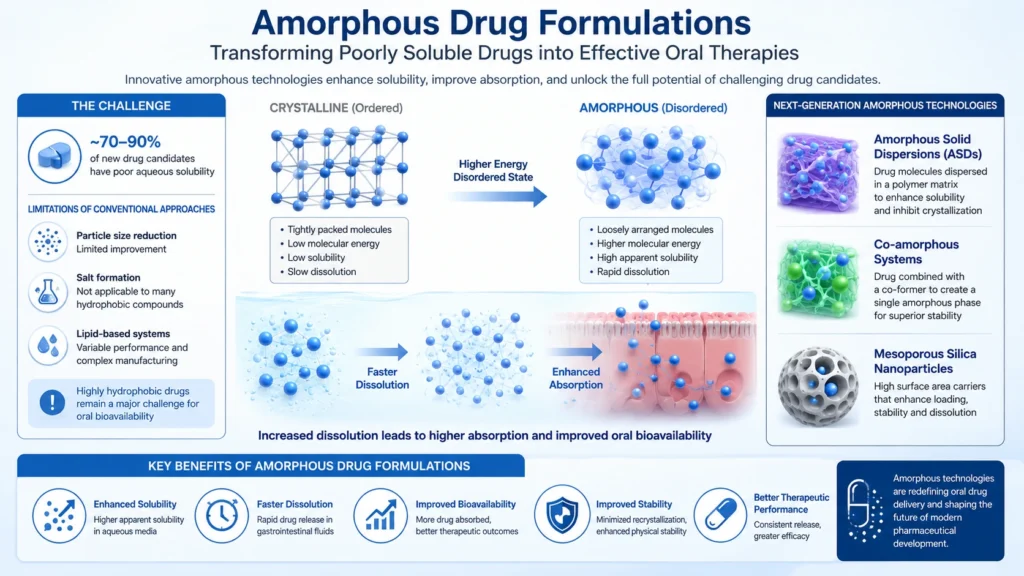
Among these innovations, amorphous drug formulations have emerged as one of the most advanced and impactful strategies for enhancing the dissolution and absorption of poorly soluble drugs. Unlike conventional crystalline forms, where drug molecules are tightly packed in an ordered lattice, amorphous drug formulation systems exist in a higher-energy, disordered molecular state that significantly increases apparent solubility and dissolution rate. This enhanced molecular mobility allows more drug to dissolve rapidly in gastrointestinal fluids, ultimately improving oral bioavailability.
Recent advances in formulation science have further expanded the potential of amorphous drug formulation technologies through approaches such as amorphous solid dispersions (ASDs), co-amorphous drug formulation systems, and mesoporous silica nanoparticle-based drug delivery. These next-generation platforms not only stabilize the inherently unstable amorphous state but also minimize recrystallization, resulting in improved physical stability, consistent drug release, and enhanced therapeutic performance. As a result, amorphous drug formulations are transforming the development of poorly soluble medicines and are increasingly becoming a cornerstone of modern oral drug delivery.
The Solubility-Bioavailability Hurdle: Why Crystalline Drugs Fall Short
Oral administration remains the most desirable route for drug delivery, it is patient-friendly, cost-effective, and supports long-term treatment adherence. Yet behind the convenience of a swallowed tablet lies a formidable and persistent obstacle: many promising therapeutic candidates never reach systemic circulation in meaningful quantities. The explanation for this failure often traces back to a single, deceptively simple property, the drug’s ability to dissolve.
The Challenge of Poor Aqueous Solubility
Aqueous solubility is the foundational requirement for any orally administered drug. Before a molecule can cross the gastrointestinal epithelium and enter the bloodstream, it must first liberate itself from the solid dosage form and dissolve into the fluids of the gut lumen. This step, often taken for granted, is where many compounds stumble.
The scope of the problem is striking. Estimates suggest that upwards of 70% of new chemical entities emerging from discovery pipelines exhibit poor aqueous solubility. These are not fringe molecules, they include kinase inhibitors for oncology, antivirals, antifungals, and a broad range of compounds targeting intracellular receptors. Their molecular features, which often confer high potency and target selectivity, simultaneously render them hydrophobic and resistant to hydration. Large aromatic ring systems, extensive conjugation, and halogen substitutions all contribute to strong crystal lattice energies and poor wetting behavior.
When a drug dissolves too slowly, or barely at all, it lingers in the gastrointestinal tract as undissolved solid, never reaching the concentrations needed to drive absorption. The dissolution rate, as described by the Noyes-Whitney equation, is directly proportional to the drug’s solubility in the local medium. A compound with aqueous solubility in the low micrograms-per-milliliter range may require a dissolution volume far exceeding that available in the gastrointestinal tract. In practical terms, the drug remains trapped in its solid form, and the therapeutic window closes before it ever opens.
Impact on Oral Bioavailability
Bioavailability is the ultimate arbiter of whether an orally administered drug can achieve its intended effect. Defined as the fraction of the administered dose that reaches the systemic circulation unchanged, it is the product of several sequential processes: dissolution, permeation, and first-pass metabolism. Poor solubility attacks this chain at its very first link.
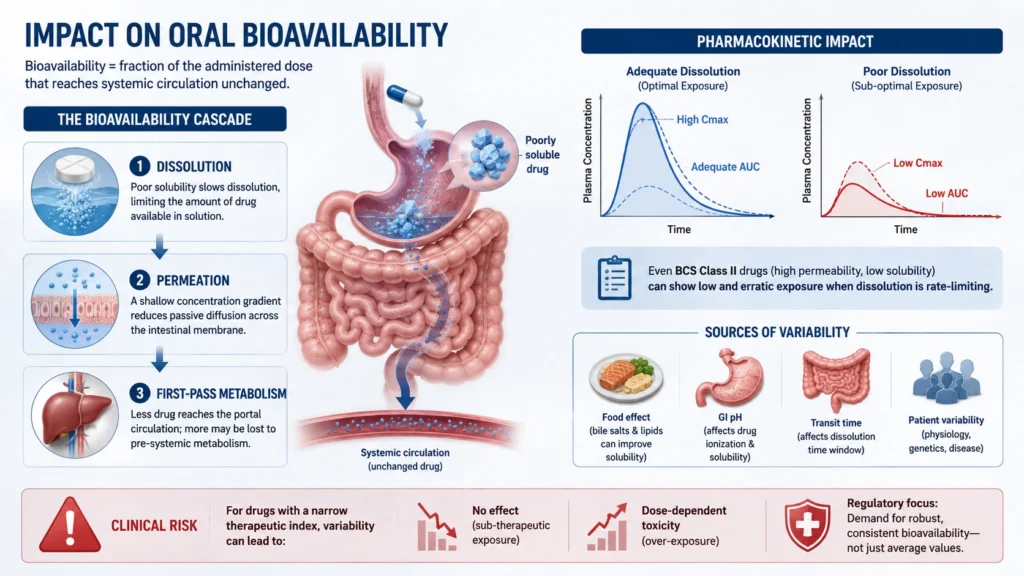
When dissolution is rate-limiting, the concentration gradient across the intestinal membrane remains shallow, and the flux of drug into the portal circulation is reduced proportionally. Even molecules with excellent intrinsic permeability, those classified under the Biopharmaceutics Classification System (BCS) as Class II, will exhibit low and erratic exposure if they cannot dissolve in time. The result is a pharmacokinetic profile marked by low C<sub>max</sub>, sub-therapeutic AUC, and often substantial variability between fasted and fed states, as food-induced bile salt and lipid secretion can transiently rescue solubility.
Beyond the numbers, this variability poses a clinical risk. A patient taking a poorly soluble drug with a narrow therapeutic index may experience either no effect or dose-dependent toxicity, depending on prandial status, GI pH, and individual transit time. Regulatory agencies have grown increasingly attentive to these risks, and the demand for robust bioavailability, not simply an average value that meets a threshold, has reshaped formulation strategy across the industry.
Why Crystalline Drugs Often Fail to Achieve Therapeutic Exposure
The crystalline state is the default solid form for most small-molecule drugs. Crystals offer chemical stability, manufacturability, and ease of characterization, attributes that make them attractive from a development standpoint. Ironically, these same attributes work against the drug when it enters the body.
A crystal is defined by its lattice energy: the sum of intermolecular forces, van der Waals interactions, hydrogen bonds, π-π stacking, that hold molecules in a periodic three-dimensional array. This lattice energy must be overcome for dissolution to occur. Every molecule that escapes into solution must break free from its neighbors, and the stronger the lattice, the higher the energetic barrier. Highly crystalline drugs, particularly those with high melting points and strong intermolecular cohesion, present an enthalpic penalty that the aqueous environment of the gut simply cannot pay.
Furthermore, the very perfection of a crystalline lattice means that dissolution proceeds from a limited surface area. Unless micronized, crystals present smooth, low-energy faces to the dissolving medium. Wetting is often poor, and the effective surface area available for solvent contact can be orders of magnitude lower than what is needed to achieve therapeutic concentrations within the intestinal transit window.
Amorphous solid dispersions, lipid-based formulations, co-crystals, and salt formation have all emerged as strategies to circumvent this fundamental limitation. Each approach, in its own way, seeks to either disrupt or bypass the crystalline lattice, elevating the drug’s apparent solubility by presenting it in a higher-energy, more readily dissolved form. The growing prevalence of these enabling technologies in approved products underscores a hard-won recognition: for many drugs, the crystal is not the optimal delivery vehicle. It is the problem.
2. What Are Amorphous Drug Formulations?
If the crystalline state represents order, the amorphous state represents its deliberate undoing. Amorphous drug formulations are solid dispersions in which the active pharmaceutical ingredient exists not as a structured crystal but as a disordered, glass-like solid, one that has lost the long-range molecular periodicity that defines a crystal lattice. In this state, molecules are frozen in a random, liquid-like arrangement, and the energetic landscape that governs their behavior changes dramatically.
The Difference Between Crystalline and Amorphous States
The distinction between crystalline and amorphous forms can be understood at both the molecular and macroscopic levels. In a crystal, each molecule occupies a defined position within a repeating unit cell. The intermolecular distances, bond angles, and spatial orientations are fixed and predictable. This order extends across millions of unit cells, creating a structure characterized by sharp X-ray diffraction peaks, well-defined melting points, and anisotropic physical properties such as distinct cleavage planes.
An amorphous solid, by contrast, lacks any such long-range order. Under X-ray diffraction, it produces only a diffuse halo, the hallmark of a material without periodic structure. There is no melting point, only a glass transition temperature (T<sub>g</sub>) above which the material softens from a rigid glass into a supercooled liquid. The molecules within an amorphous matrix adopt a distribution of conformations and intermolecular distances, much as they would in a liquid, but are immobilized by the high viscosity of the solid state.
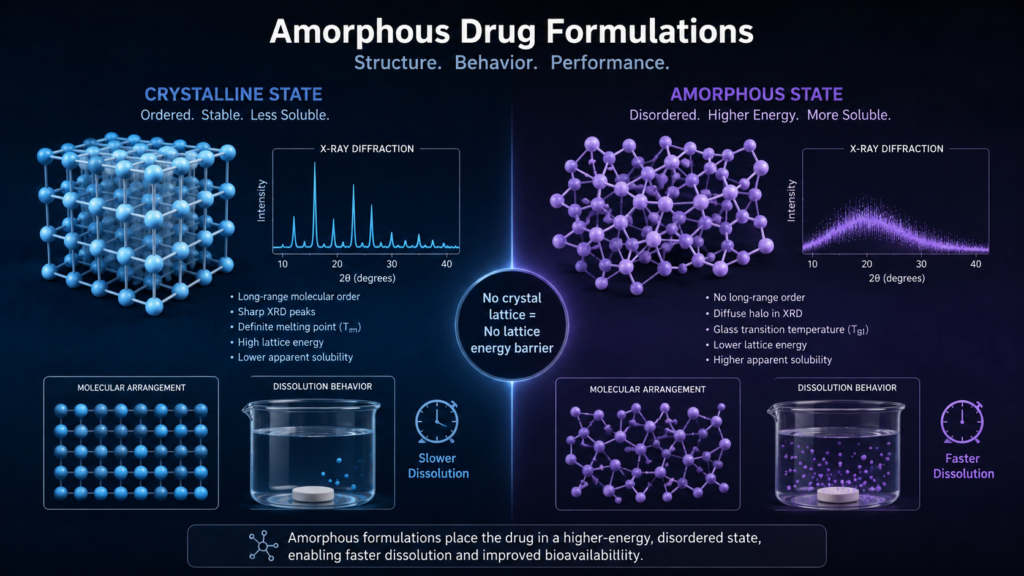
This structural distinction has profound pharmaceutical consequences. The absence of a crystal lattice means there is no lattice energy to overcome. An amorphous drug does not need to break free from an ordered array of neighbors; it already exists in a state of higher molecular disorder. As a result, when it contacts an aqueous medium, the dissolution process requires significantly less energy input, and the drug can transition into solution far more readily than its crystalline counterpart.
Higher Free Energy and Apparent Solubility
The practical advantage of the amorphous form rests on a thermodynamic principle: the amorphous state possesses higher free energy than the crystalline state. This is a direct consequence of its molecular disorder. In a crystal, molecules occupy the lowest-energy arrangement available to them under given conditions, the thermodynamic ground state. An amorphous solid, having been processed to prevent crystallization (typically through melt quenching, spray drying, or solvent evaporation), traps molecules in higher-energy conformations and positions.
This excess free energy translates into a measurable increase in apparent solubility. Because the amorphous form does not pay the energetic penalty of lattice disruption, the concentration of drug achievable in solution, at least transiently, can exceed the equilibrium solubility of the crystalline form by an order of magnitude or more. This phenomenon is sometimes described as “supersaturation”: the drug dissolves to a concentration above its thermodynamic solubility limit, driven by the higher chemical potential of the amorphous starting material.
The implications for oral bioavailability are immediate and compelling. For a BCS Class II drug whose absorption is dissolution-rate-limited, switching from a crystalline to an amorphous drug formulation can transform the pharmacokinetic profile. The dissolution rate accelerates, the luminal concentration climbs higher, and the driving force for intestinal permeation strengthens. Drugs that once failed to reach therapeutic plasma levels can, when formulated as amorphous solid dispersions, achieve consistent and clinically meaningful exposure. This is not a marginal improvement, it can be the difference between a failed development program and a marketed product.
Thermodynamic Instability and Recrystallization Risks
Yet the very property that makes amorphous drug formulations powerful, their elevated free energy, also makes them vulnerable. Thermodynamically, every amorphous drug seeks to return to the lower-energy crystalline state. The question is not whether recrystallization will occur, but when and under what conditions.
The stability of an amorphous drug formulation hinges on molecular mobility. Below the glass transition temperature, the material exists as a rigid glass in which molecular motion is severely restricted. In this state, the kinetic barrier to crystallization can be sufficient to preserve the amorphous form throughout the product’s shelf life. However, if the temperature rises above T<sub>g</sub>, or if the material absorbs moisture, water being a potent plasticizer that depresses T<sub>g</sub>, molecular mobility increases sharply. Chains and rings gain the freedom to reorient, and the slow, inexorable march toward the crystalline ground state begins.
Recrystallization is not merely a physical curiosity; it is a pharmaceutical failure mode. Once a drug recrystallizes within a tablet or capsule, the solubility advantage of the amorphous form is lost. The dissolution rate drops back to that of the crystalline material, and bioavailability suffers accordingly. Worse, recrystallization may occur non-uniformly, producing batch-to-batch variability, or during storage under humid conditions, undermining product reliability.
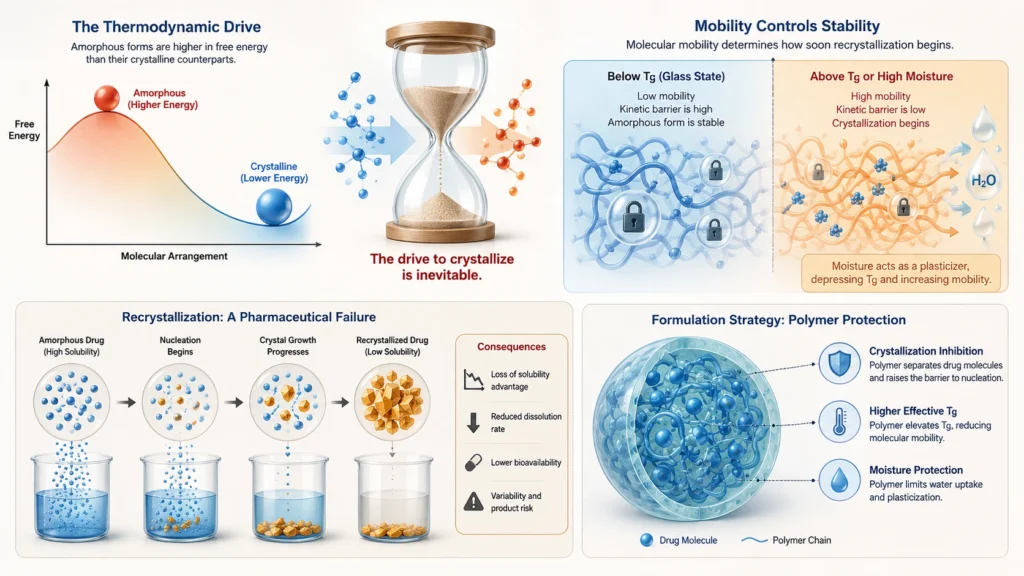
Managing this risk requires deliberate formulation strategy. Amorphous drug formulations are rarely used alone; they are almost always embedded within a polymeric carrier matrix that serves multiple functions. The polymer acts as a crystallization inhibitor, physically separating drug molecules and raising the energy barrier for nucleation. It can also elevate the effective T<sub>g</sub> of the dispersion, reduce molecular mobility, and shield the drug from moisture. Polymers such as polyvinylpyrrolidone (PVP), hydroxypropyl methylcellulose acetate succinate (HPMCAS), and copovidone have become workhorses of amorphous solid dispersion technology precisely because they address these stability challenges.
3. Co-Amorphous Systems
While polymeric amorphous solid dispersions have dominated the formulation landscape for decades, a more recent and elegant strategy has emerged: the co-amorphous drug formulation system. Unlike traditional amorphous solid dispersions, which rely on a large mass fraction of polymer to stabilize the drug, co-amorphous drug formulation systems are binary or multicomponent mixtures composed exclusively of small molecules, typically a drug paired with another drug, a small-molecule excipient, or a co-former, that together form a homogeneous, single-phase amorphous solid.
Principle and Design
The core principle of a co-amorphous drug formulation system is deceptively simple: replace the bulky polymer with a low-molecular-weight partner that can interact with the drug at the molecular level. The resulting mixture is not a solid dispersion in the classical sense but a single amorphous phase in which both components are intimately mixed and mutually stabilized.
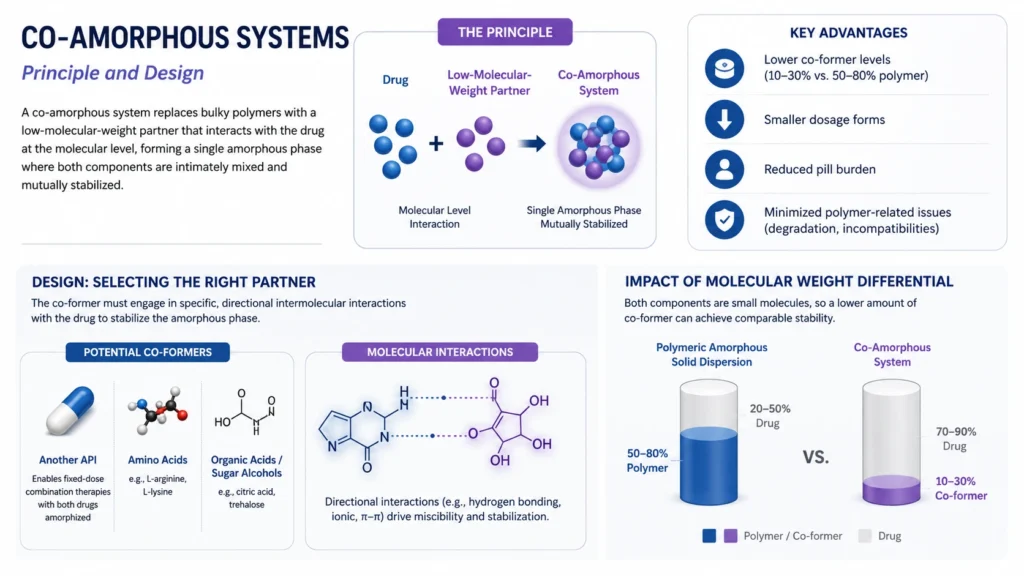
The design of a co-amorphous drug formulation system begins with the selection of an appropriate partner molecule. Unlike polymers, which stabilize primarily through steric hindrance and the elevation of bulk T<sub>g</sub>, a small-molecule co-former must engage in specific, directional intermolecular interactions. This partner may be another active pharmaceutical ingredient, opening the door to fixed-dose combination therapies where both drugs benefit from amorphization, or a carefully chosen excipient such as an amino acid, organic acid, or sugar alcohol.
The molecular weight differential between drug and co-former carries important implications. Because both components are small molecules, the overall mass fraction of the stabilizing partner can be far lower than in a polymeric dispersion. Where a polymer-based amorphous solid dispersion might require 50–80% polymer by weight, a co-amorphous drug formulation system can often achieve comparable stability with as little as 10–30% co-former. This translates directly into smaller dosage forms, reduced pill burden for the patient, and fewer concerns about polymer-related degradation products or incompatibilities.
Drug–Drug and Drug–Excipient Interactions
The versatility of the co-amorphous drug formulation approach is reflected in the diversity of partner molecules that have been successfully employed. Two broad categories define the field: drug–drug combinations and drug–excipient systems.
Drug–drug co-amorphous drug formulations pair two active pharmaceutical ingredients, each serving simultaneously as the stabilizer for the other. This approach is particularly attractive when both drugs exhibit poor aqueous solubility, creating a mutual benefit that neither could achieve alone. Examples from the literature include combinations of non-steroidal anti-inflammatory drugs, antiviral agents, and cardiovascular therapeutics. Beyond solubility enhancement, this strategy simplifies manufacturing for fixed-dose combinations and eliminates the need for an inert excipient that contributes no therapeutic value.
Drug–excipient co-amorphous drug formulation systems, by contrast, pair the active ingredient with a small-molecule excipient selected specifically for its stabilizing capability. Amino acids, particularly arginine, tryptophan, and phenylalanine, have proven especially effective due to their carboxylic acid and amine functional groups, which can participate in both hydrogen bonding and ionic interactions. Organic acids such as citric acid, tartaric acid, and succinic acid are also widely used, as are saccharides and sugar alcohols. The choice of excipient is guided not only by its ability to interact with the drug but also by its glass-forming ability, hygroscopicity, and toxicological acceptability.
The distinction between these two categories blurs in practice. A co-amorphous drug formulation system designed as a drug–drug combination may also benefit from the stabilizing influence of one drug’s functional groups on the other, and a drug–excipient system may be selected partly because the excipient itself has demonstrated pharmacological activity, as in the case of amino acids used in parenteral nutrition or bile acids that influence drug absorption.
Stabilization Through Hydrogen Bonding and Ionic Interactions
What sets co-amorphous drug formulation systems apart from their polymeric counterparts is the nature and specificity of the intermolecular forces that underpin their stability. In a polymeric amorphous solid dispersion, the dominant stabilization mechanism is often nonspecific: the polymer simply increases the bulk viscosity and T<sub>g</sub> of the matrix, reducing molecular mobility and thereby slowing the kinetics of nucleation and crystal growth. Drug–polymer hydrogen bonds may contribute, but they are often incidental rather than engineered.
Co-amorphous drug formulation systems, by contrast, are designed around specific, directional interactions. Hydrogen bonding is the most common and versatile of these. Drugs and co-formers bearing complementary hydrogen bond donors and acceptors, hydroxyl, carboxyl, amide, amine, and carbonyl groups, can form a network of intermolecular bridges that rivals the cohesive energy of a crystal lattice. These interactions are not merely passive; they actively compete with the drug’s tendency to self-associate into crystalline nuclei. Each hydrogen bond formed between drug and co-former is one that cannot be used to build a drug–drug crystal.
Even more powerful are ionic interactions, which arise when the drug and co-former exist in ionized states that can form a salt or a strongly bound ion pair. The electrostatic attraction between a protonated amine and a deprotonated carboxylic acid, for example, can exceed the strength of hydrogen bonds by an order of magnitude. Such interactions have been exploited in co-amorphous drug formulation systems containing basic drugs paired with acidic amino acids or carboxylic acid excipients, and in systems combining acidic drugs with basic amino acids like arginine. The resulting ionic network creates a formidable kinetic barrier to recrystallization.
The combined effect of these interactions is a degree of molecular-level mixing that approaches the intimacy of a true solid solution. Spectroscopic techniques, Fourier-transform infrared spectroscopy (FTIR), solid-state nuclear magnetic resonance (ssNMR), and Raman spectroscopy, have consistently confirmed the presence of drug–co-former hydrogen bonds and ionic interactions in co-amorphous drug formulation systems. These data are often correlated with physical stability studies showing that co-amorphous drug formulations resist recrystallization for months or years under accelerated storage conditions that would cause a pure amorphous drug formulation to revert to its crystalline form within days.
Advantages Over Polymeric Amorphous Solid Dispersions
The co-amorphous approach is not merely a scientific curiosity or a niche alternative to polymer-based dispersions; it addresses several well-recognized limitations of the polymeric platform.
Reduced bulk and higher drug loading. Perhaps the most practical advantage is the dramatic reduction in the mass of stabilizing agent required. A polymer-based amorphous solid dispersion for a high-dose drug may require tablets so large that patient acceptance becomes a concern, particularly for geriatric or pediatric populations or for regimens requiring multiple daily doses. Co-amorphous drug formulation systems routinely achieve drug loadings of 50–90% by weight, producing dosage forms that are smaller, easier to swallow, and more amenable to fixed-dose combinations.
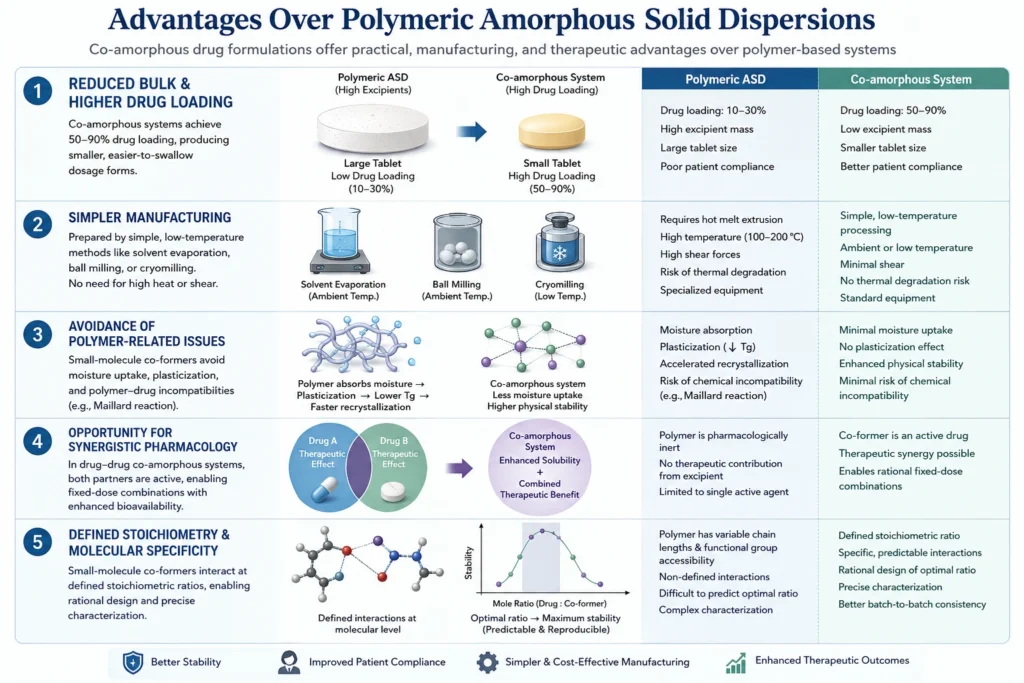
Simpler manufacturing. The processing of polymeric amorphous solid dispersions, particularly by hot melt extrusion, demands high temperatures and high shear forces to achieve adequate mixing of drug and polymer. These conditions can cause thermal degradation of heat-sensitive compounds and require specialized equipment. Co-amorphous drug formulations can often be prepared by simpler methods such as solvent evaporation, ball milling, or cryomilling, operating at or near ambient temperature and avoiding the thermal stress associated with melt processing.
Avoidance of polymer-related issues. Polymers are not pharmaceutically inert in all contexts. They can absorb moisture from the environment, and the absorbed water acts as a plasticizer that depresses T<sub>g</sub> and accelerates recrystallization, a phenomenon that ironically undermines the very purpose of the polymer. Certain polymers can also participate in drug–excipient chemical incompatibilities, such as the Maillard reaction between reducing sugar end-groups and primary amines. Co-amorphous drug formulation systems built from well-chosen small molecules can sidestep these issues entirely.
Opportunity for synergistic pharmacology. In drug–drug co-amorphous drug formulation systems, the stabilizing partner is not a mere spectator; it contributes its own pharmacological activity. This opens the possibility of fixed-dose combinations in which both drugs are rendered more bioavailable by their mutual amorphization. For chronic conditions requiring polypharmacy, hypertension, diabetes, HIV, tuberculosis, this represents a convergence of formulation science and therapeutic strategy that polymeric systems cannot match.
Defined stoichiometry and molecular specificity. Unlike a polymer, which presents a statistical distribution of chain lengths and functional group accessibility, a small-molecule co-former engages with the drug at a defined stoichiometric ratio. This predictability allows for rational design: the ideal molar ratio of drug to co-former can be predicted from the number and type of interacting functional groups, and the resulting system can be characterized with a precision that polymer-based dispersions resist.
Co-amorphous systems, then, represent not a replacement for polymeric amorphous solid dispersions but a complementary tool in the formulation scientist’s armamentarium. For drugs where polymer loading would be prohibitive, where thermal processing poses a risk, or where a second active ingredient is already indicated, the co-amorphous approach offers a route to enhanced oral bioavailability that is at once scientifically elegant and practically advantageous.
4. Mesoporous Silica Nanoparticles (MSNs)
Mesoporous silica nanoparticles (MSNs) have emerged as one of the most promising nanotechnology-based carriers for enhancing the oral delivery of poorly soluble drugs. Characterized by their highly ordered porous architecture, large surface area, tunable pore size, and excellent biocompatibility, MSNs provide an ideal platform for stabilizing drugs in their amorphous state while significantly improving dissolution and bioavailability.
Structure and Pore Characteristics
MSNs are composed of a rigid silica framework containing a network of uniformly distributed mesopores, typically ranging from 2 to 50 nm in diameter. This unique porous structure offers an exceptionally high surface area, often exceeding 500–1,000 m²/g, and a large pore volume, enabling substantial drug loading within the nanoparticle matrix. The pore size, surface chemistry, and particle morphology can be precisely engineered to accommodate a wide range of active pharmaceutical ingredients (APIs), making MSNs highly versatile drug delivery systems. Furthermore, their chemically modifiable surface allows functionalization with polymers, targeting ligands, or stimuli-responsive molecules to further enhance stability and therapeutic performance.
Confinement Effect: Preventing Crystallization
One of the most significant advantages of MSNs is their ability to maintain drugs in an amorphous state through the nanoconfinement effect. When drug molecules are confined within the nanoscale pores of the silica matrix, they lack the physical space required to reorganize into an ordered crystal lattice. This spatial restriction effectively suppresses nucleation and crystal growth, thereby preventing recrystallization during storage and after administration.
In addition to physical confinement, weak intermolecular interactions such as hydrogen bonding and van der Waals forces between the drug molecules and the silica surface further stabilize the amorphous form. This dual stabilization mechanism helps preserve the enhanced solubility and dissolution characteristics of the drug throughout its shelf life.
Drug Loading Approaches
Several techniques have been developed to incorporate drugs into mesoporous silica nanoparticles, with the choice of method depending on the physicochemical properties of the drug and the desired release profile. The most widely employed approach is the solvent impregnation (solvent evaporation) method, in which the drug is dissolved in a suitable solvent and allowed to diffuse into the nanopores before solvent removal, leaving the drug molecularly dispersed within the silica framework.
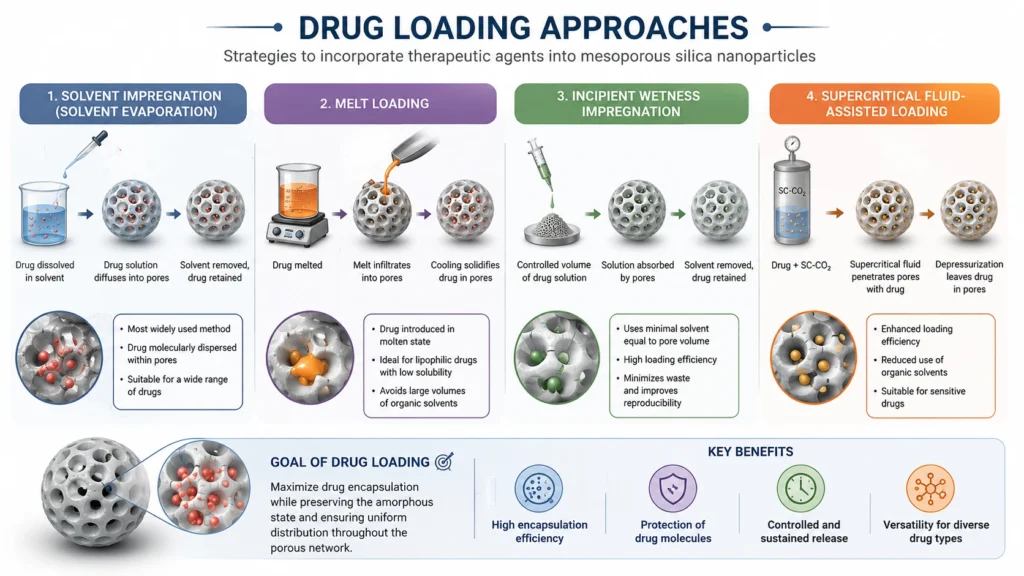
Other commonly investigated methods include melt loading, where the drug is introduced into the pores in its molten state; incipient wetness impregnation, which utilizes a carefully controlled volume of drug solution matching the pore volume; and supercritical fluid-assisted loading, an advanced technique that improves loading efficiency while minimizing the use of organic solvents. Each method aims to maximize drug encapsulation while preserving the amorphous state and ensuring uniform distribution throughout the porous network.
Controlled Release and Improved Dissolution
Beyond stabilizing amorphous drug formulations, MSNs play a critical role in enhancing dissolution and enabling controlled drug release. Their enormous surface area increases the contact between the drug and gastrointestinal fluids, while the molecular dispersion of the drug within the nanopores eliminates the need for crystal dissolution, resulting in a rapid increase in apparent solubility and dissolution rate.
At the same time, the pore architecture and surface modifications can be tailored to regulate the diffusion of drug molecules, allowing sustained or site-specific release depending on therapeutic requirements. Surface functionalization with polymers or pH-responsive materials further enables modulation of release kinetics, protecting sensitive drugs during gastrointestinal transit and promoting targeted drug delivery.
Collectively, these attributes make mesoporous silica nanoparticles an advanced platform for overcoming the limitations of poorly soluble drugs. By combining efficient drug loading, stabilization of the amorphous state, suppression of recrystallization, and enhanced dissolution performance, MSNs continue to play a pivotal role in the development of next-generation oral drug delivery systems.
Conclusion
The development of amorphous drug formulation has fundamentally changed the way formulation scientists address the persistent challenge of poor aqueous solubility. Throughout this first part of the article, we have explored why conventional crystalline dosage forms often fail to deliver adequate therapeutic exposure and how amorphous drug formulation provides an effective strategy to overcome these limitations. By transforming an active pharmaceutical ingredient from a highly ordered crystalline structure into a disordered, high-energy state, amorphous drug formulation significantly improves apparent solubility, dissolution rate, and ultimately oral bioavailability.
Despite these remarkable advantages, amorphous drug formulation is accompanied by the inherent challenge of thermodynamic instability and the tendency to recrystallize. Consequently, the long-term success of amorphous drug formulation depends on selecting appropriate stabilization strategies capable of maintaining the amorphous state throughout manufacturing, storage, and administration. Modern pharmaceutical research has demonstrated that the future of amorphous drug formulation lies not only in generating the amorphous state but also in preserving it under real-world conditions.
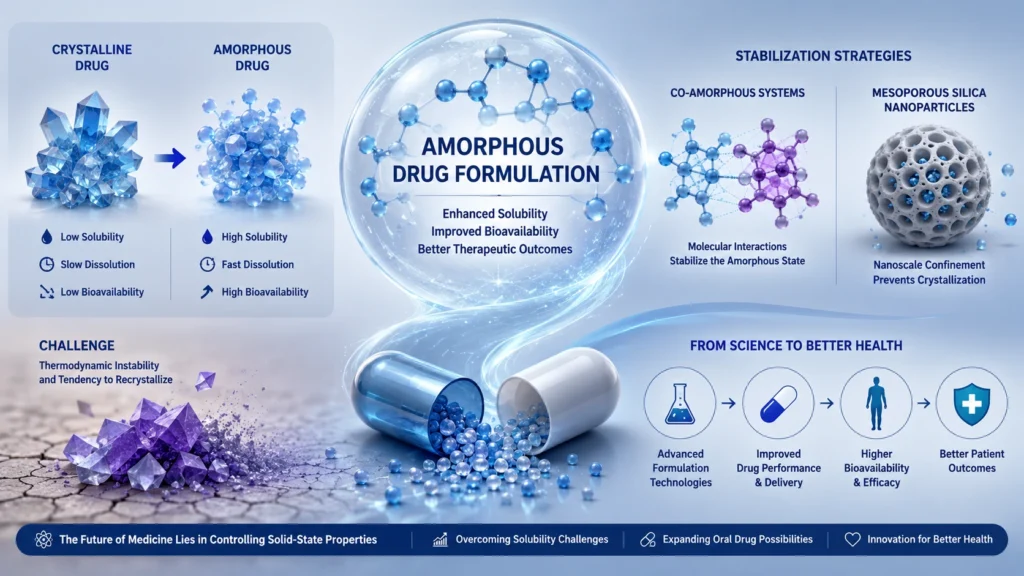
Among the most significant advances discussed in this article are co-amorphous systems and mesoporous silica nanoparticles, both of which have expanded the possibilities of amorphous drug formulation. Co-amorphous systems stabilize drug molecules through carefully designed molecular interactions, while mesoporous silica nanoparticles utilize nanoscale confinement to prevent crystallization and preserve the performance of amorphous drug formulation. These complementary technologies illustrate how material science and pharmaceutical engineering continue to enhance the effectiveness of amorphous drug formulation for increasingly complex drug molecules.
The evolution of amorphous drug formulation represents far more than an alternative formulation approach, it reflects a shift toward designing medicines that maximize therapeutic performance by controlling solid-state properties. As the number of poorly soluble drug candidates continues to rise, amorphous drug formulation will play an increasingly important role in improving patient outcomes, enabling higher bioavailability, reducing formulation barriers, and expanding the range of compounds suitable for oral delivery. Continued innovation in amorphous drug formulation will help pharmaceutical scientists address challenges that conventional crystalline systems cannot overcome.
The future of amorphous drug formulation will rely on integrating advanced excipients, nanotechnology, computational modeling, and predictive formulation science to produce more stable, scalable, and commercially viable products. Every advancement in amorphous drug formulation contributes to improving dissolution performance, reducing recrystallization, and enhancing therapeutic efficacy. As research progresses, amorphous drug formulation will remain one of the most influential technologies for developing next-generation oral medicines and overcoming the solubility limitations that continue to challenge pharmaceutical development.
References
- Lipinski, C. A. (2004). Lead- and drug-like compounds: The Rule-of-Five revolution. Drug Discovery Today: Technologies, 1(4), 337–341.
- Savjani, K. T., Gajjar, A. K., & Savjani, J. K. (2012). Drug solubility: Importance and enhancement techniques. ISRN Pharmaceutics, 2012, 195727.
- Kawabata, Y., Wada, K., Nakatani, M., Yamada, S., & Onoue, S. (2011). Formulation design for poorly water-soluble drugs based on biopharmaceutics classification system: Basic approaches and practical applications. International Journal of Pharmaceutics, 420(1), 1–10.
- Hancock, B. C., & Zografi, G. (1997). Characteristics and significance of the amorphous drug formulation state in pharmaceutical systems. Journal of Pharmaceutical Sciences, 86(1), 1–12.
- Yu, L. (2001). Amorphous pharmaceutical solids: Preparation, characterization and stabilization. Advanced Drug Delivery Reviews, 48(1), 27–42.
- Bhugra, C., & Pikal, M. J. (2008). Role of thermodynamic, molecular, and kinetic factors in crystallization from the amorphous drug formulation state. Journal of Pharmaceutical Sciences, 97(4), 1329–1349.
- Newman, A., & Zografi, G. (2014). Considerations in the assessment of amorphous solid dispersions. Journal of Pharmaceutical Sciences, 103(9), 2595–2608.
- Baghel, S., Cathcart, H., & O’Reilly, N. J. (2016). Polymeric amorphous solid dispersions: A review of formulation strategies and manufacturing techniques. Journal of Pharmaceutical Sciences, 105(9), 2527–2544.
- Löbmann, K., Laitinen, R., Grohganz, H., Gordon, K. C., Strachan, C. J., & Rades, T. (2013). Co-amorphous drug systems: Enhanced physical stability and dissolution rate of poorly water-soluble drugs. International Journal of Pharmaceutics, 453(1), 80–87.
- Dengale, S. J., Grohganz, H., Rades, T., & Löbmann, K. (2016). Recent advances in co-amorphous drug formulations. Advanced Drug Delivery Reviews, 100, 116–125.
- Chieng, N., & Rades, T. (2018). Co-amorphous pharmaceutical systems for improving solubility and stability. Expert Opinion on Drug Delivery, 15(9), 1–16.
- Vallet-Regí, M., Ramila, A., del Real, R. P., & Pérez-Pariente, J. (2001). A new property of MCM-41: Drug delivery system. Chemistry of Materials, 13(2), 308–311.
- Vallet-Regí, M., Balas, F., & Arcos, D. (2007). Mesoporous materials for drug delivery. Angewandte Chemie International Edition, 46(40), 7548–7558.
- Slowing, I. I., Vivero-Escoto, J. L., Wu, C. W., & Lin, V. S. Y. (2008). Mesoporous silica nanoparticles as controlled release drug delivery systems. Advanced Drug Delivery Reviews, 60(11), 1278–1288.
- Mamaeva, V., Sahlgren, C., & Lindén, M. (2013). Mesoporous silica nanoparticles in medicine—Recent advances. Advanced Drug Delivery Reviews, 65(5), 689–702.
- Tang, F., Li, L., & Chen, D. (2012). Mesoporous silica nanoparticles: Synthesis, biocompatibility and drug delivery. Advanced Materials, 24(12), 1504–1534.
- Kwon, S., Singh, R. K., Perez, R. A., Neel, E. A. A., Kim, H. W., & Chrzanowski, W. (2013). Silica-based mesoporous nanoparticles for controlled drug delivery. Journal of Tissue Engineering, 4, 1–14.
- Qian, K. K., Bogner, R. H., & Zhou, D. (2011). Application of mesoporous silicon dioxide and silica in oral amorphous drug delivery systems. Journal of Pharmaceutical Sciences, 100(9), 3897–3912.
- Van Speybroeck, M., Mellaerts, R., Mols, R., et al. (2010). Enhanced absorption of poorly soluble drugs using ordered mesoporous silica. European Journal of Pharmaceutics and Biopharmaceutics, 75(3), 354–365.
- ICH. (2023). ICH Q8(R2): Pharmaceutical Development. International Council for Harmonisation of Technical Requirements for Pharmaceuticals for Human Use.
- ICH. (2023). ICH Q9(R1): Quality Risk Management. International Council for Harmonisation of Technical Requirements for Pharmaceuticals for Human Use.
- ICH. (2023). ICH Q10: Pharmaceutical Quality System. International Council for Harmonisation of Technical Requirements for Pharmaceuticals for Human Use.